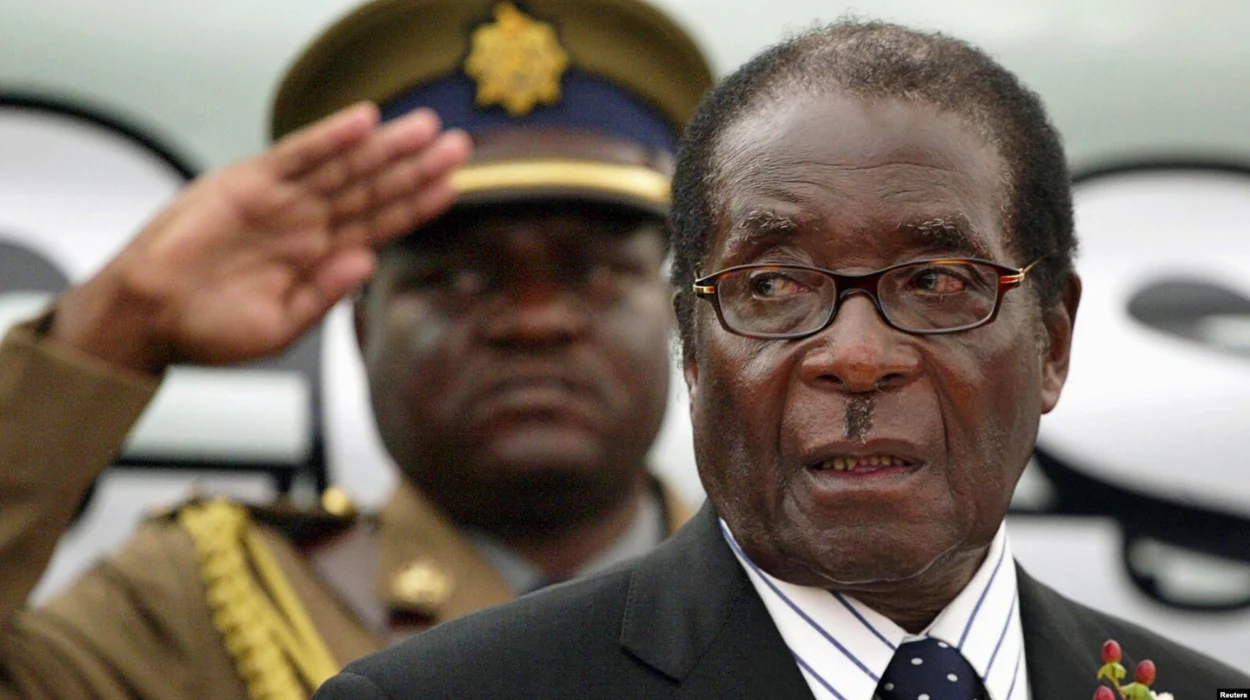
UK (Parliament Politics Magazine) – Documents reveal the UK Foreign Office considered options to handle ex-Zimbabwean President Robert Mugabe in 2004, but ruled out military action due to risks.
As reported by Caroline Davies and Ben Quinn in The Guardian, newly released documents show the UK Foreign Office ruled out military action against former Zimbabwean president Robert Mugabe in 2004, calling it “not a serious option.”
What did UK policy papers reveal about Tony Blair’s options on Robert Mugabe?
Policy papers show that former prime minister Tony Blair’s government considered several approaches to responding to the “depressingly healthy” 80-year-old dictator, as his refusal to step aside fuelled violence and economic decline.
Ahead of a 2005 election expected to be won by Mugabe’s Zanu-PF, and following Britain’s role in the US-led invasion of Iraq, Number 10 asked the Foreign Office in July 2004 to prepare possible courses of action.
Documents published at the National Archives in Kew show officials accepted that efforts to isolate Mugabe and build international support for change were ineffective, particularly in winning backing from influential African leaders such as South African president Thabo Mbeki.
Officials considered several options: forcibly removing Mugabe, imposing tougher UK measures such as asset freezes and embassy closure, or re-engaging, a route backed by the outgoing ambassador of Zimbabwe, Brian Donnelly.
The FCO paper rejected military action as not a “serious option,” and advised,
“We know from Afghanistan, Iraq and Yugoslavia that changing a government and/or its bad policies is almost impossible from the outside. If we really wanted to change the situation on the ground in Zimbabwe we have to do to Mugabe what we have just done to Saddam.”
It adds,
“The only candidate for leading such a military operation is the UK. No one else (even the US) would be prepared to do so.”
The documents warn that a military operation could cause heavy casualties and serious consequences for British citizens in Zimbabwe.
It says,
“Short of a major humanitarian and political catastrophe – resulting in massive violence, large-scale refugee flows, and regional instability – we judge that no African state would agree to any attempts to remove Mugabe forcibly.”
It continues,
“Nor do we judge that any other European, Commonwealth or western partner (including the US) would authorise or participate in military intervention. And there would be no legal grounds for doing so, without an authorising Security Council Resolution, which we would not get.”
Laurie Lee, advising Blair on foreign policy, warned that Zimbabwe could disrupt the UK’s G8 plans to make 2005 “the year of Africa.” With military action ruled out, he suggested pursuing a longer-term strategy and re-engaging with Mugabe.
The former Prime Minister appeared to agree, writing,
“We should work out a way of exposing the lies and malpractice of Mugabe and Zanu-PF up to this election and then afterwards, we could try-to re-engage on the basis of a clear understanding of what that means. So we could try a variant of what Brian D [Donnelly] says. I can see a way of making it work but we need to have the FCO work out a complete strategy.”
In his farewell telegram, Donnelly urged careful re-engagement with Mugabe, noting that Mr Blair
“might shudder at the thought given all that Mugabe has said and done.”
The 93-year-old Mugabe was finally removed from power in a 2017 coup. Former South African President Mbeki later claimed Blair had sought his support for a military action against Mugabe, which Blair denied.
What was the G8 “year of Africa” initiative?
The “year of Africa” refers to the 2005 G8 Summit in Gleneagles, Scotland, where African development was the top priority.
The purpose was to help Africa grow by doubling aid, canceling debt, and making trade easier. This plan worked as a partnership with African countries, relying on their promises to improve governance and follow economic reforms through NEPAD.
At the summit, G8 leaders promised to increase aid to Africa by $25 billion each year by 2010. They also agreed to cancel all multilateral debt for many of the world’s poorest countries, most of which are in Africa.