

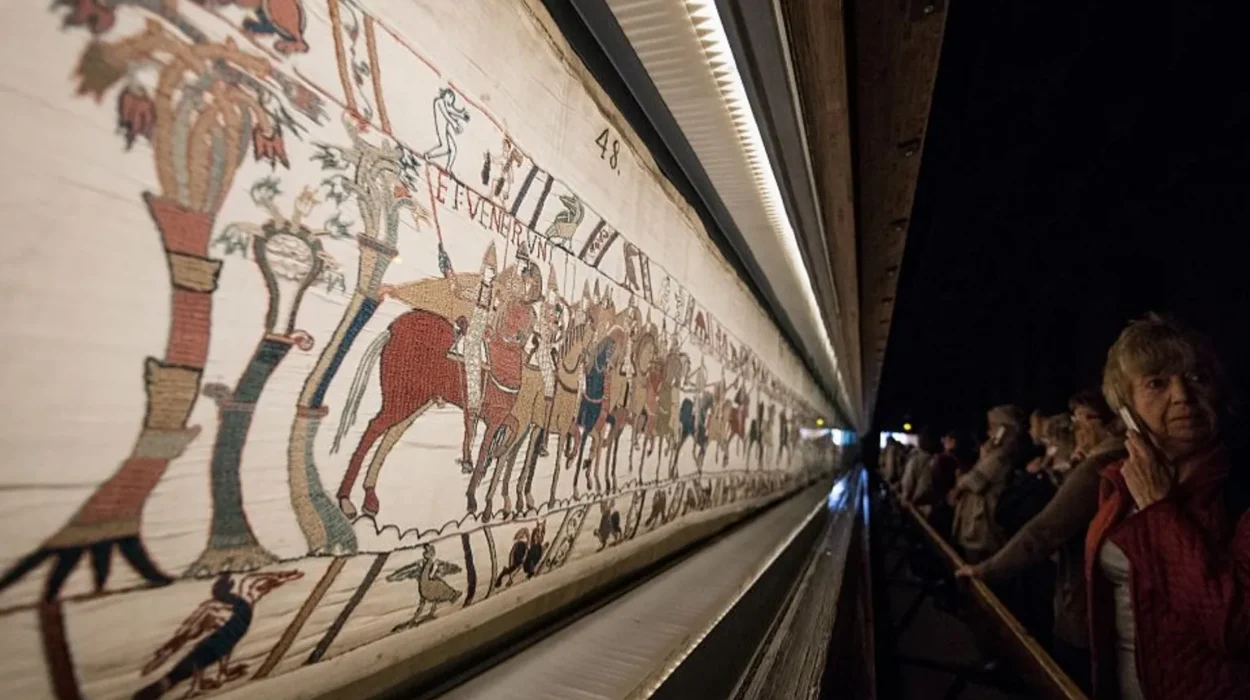
UK (Parliament Politics Magazine) – The UK Treasury plans £800m insurance for the Bayeux Tapestry during its loan to the British Museum, ensuring protection in transit and on display.
As reported by Fiona Nimoni of the BBC, the UK Treasury will insure the Bayeux Tapestry for an estimated £800m during its loan to the British Museum next year.
How will the UK protect the Bayeux Tapestry during its Loan?
As part of a Franco-British agreement, the 70-metre Bayeux Tapestry, depicting the 1066 Battle of Hastings, will be transported to London.
The Government Indemnity Scheme will insure the artefact during transport, storage, and exhibition, while covering potential loss or damage.
The Treasury stated that, without the long-standing scheme,
“public museums and galleries would face a substantial commercial insurance premium, which would be significantly less cost effective.”
Some French experts have raised concerns over the transfer, saying the millennium-old artefact is too fragile to move, though French authorities have rejected these warnings.
The Treasury has reportedly received an initial valuation for insuring the Bayeux Tapestry, which has been provisionally approved. The loan will be confirmed after the final assessment.
Culture Secretary Lisa Nandy described the loan
“a symbol of our shared history with our friends in France, a relationship built over centuries and one that continues to endure.”
According to the Financial Times, citing unnamed officials, the final valuation is expected to be around £800m. The Treasury did not offer any comment when approached for a remark.
The Bayeux Tapestry is set to be displayed at the British Museum’s Sainsbury Exhibitions Gallery from September next year until July 2027, as the Bayeux Museum undergoes renovations.
The huge tapestry, featuring 58 scenes, 626 figures, and 202 horses, depicts the contested era when William the Conqueror took the English throne from Harold Godwinson, marking the start of Norman rule in England.
The British government’s indemnity scheme enables art and cultural objects to be exhibited publicly, even when insurance costs would otherwise make this impossible.
The scheme, established in 1980, has supported many high-value loans, including Vincent van Gogh’s The Bedroom to the National Gallery.
The government-backed scheme is projected to save museums and galleries nearly £81m annually compared with commercial insurance costs.
As part of the deal for the Bayeux Tapestry, France will receive loans from the British Museum, including 7th-century Sutton Hoo Anglo-Saxon artefacts and 12th-century Lewis chess pieces.
What did the British Museum director and trustees say about the Bayeux Tapestry exhibition?
The British Museum’s director, Nicholas Cullinan, said,
“This is exactly the kind of international partnership that I want us to champion and take part in: sharing the best of our collection as widely as possible – and in return displaying global treasures never seen here before.”
George Osborne, chair of the British Museum’s trustees, said the exhibition
“will be the blockbuster show of our generation,”
comparable to past displays of Tutankhamun and the Terracotta Warriors.
He said,
“There is no other single item in British history that is so familiar, so studied in schools, so copied in art as the Bayeux Tapestry. Yet in almost 1,000 years it has never returned to these shores.”
Mr Osborne added,
“Next year it will and many, many thousands of visitors, especially schoolchildren, will see it with their own eyes.”
How many male figures are nude on the Bayeux Tapestry?
The Bayeux Tapestry’s depiction of male nudity has sparked debate, with the original remaining in Bayeux, France, and a 19th-century replica held at Reading Museum.
The Leek Embroidery Society’s replica did not include most of the penises, having relied on censored sources. In 2018, Oxford academic Prof. George Garnett counted 93 in total, 88 on horses and five on human figures.
He said,
“If you look at what are incontrovertibly penises in the tapestry, none of them have a yellow blob on the end.”
Dr David Musgrove stated,
“It might be that [the penises] are just there for fun and for levity, that’s what some scholars say. Some say the figures are making some sort of commentary on the action in the main scene, some sort of subversive commentary, perhaps even casting doubt on the probity of some of the characters in the main scene.”
He added,
“Some people say they’re something to do with Aesop’s fables. There are lots of interesting theories – we don’t know really, to be honest. But it’s very interesting that they’re there.”
How old is the Bayeux Tapestry?
The Bayeux Tapestry is a medieval artifact created in the immediate aftermath of the event it depicts. It was established in the 11th century, most likely in the 1070s, shortly after the Norman Conquest of England in 1066.
The tapestry is an embroidered narrative that tells the story of the conquest, culminating in the Battle of Hastings (1066), from the Norman perspective. Scholars believe it was commissioned by Bishop Odo of Bayeux, William the Conqueror’s half-brother.