

Paris (Parliament Politics Magazine) – Ukrainian President Volodymyr Zelensky says “tough issues” remain unresolved after Florida talks, while touring Europe to meet allies and push back against Russian demands.
As reported by Reuters, Ukrainian President Volodymyr Zelensky stated that key challenges persist following Florida talks, as Ukrainian officials tour Europe and US President Trump’s envoy prepares to meet Russian President Vladimir Putin in Moscow.
The Florida talks on Ukraine peace were held on November 30, 2025. The Ukrainian delegation was led by Rustem Umerov, Secretary of the National Security and Defense Council of Ukraine.
The US delegation included Secretary of State Marco Rubio, Special Envoy Steve Witkoff, and Jared Kushner, the son-in-law of President Donald Trump.
What did Volodymyr Zelensky say about the post-Florida talks?
Ukrainian President Volodymyr Zelensky said tough issues remain after Florida talks, as he prepares for meetings across Europe to discuss next steps.
He added,
“There are some tough issues that still have to be worked through. It will be a very substantive day.”
Mr Zelensky called the Florida discussions “very constructive” and said his delegation will return to Europe to continue talks.
He said,
“After speaking with them and receiving a full report on how the negotiations went, we will decide on our further activities.”
The Ukrainian prime minister added,
“And for today, we have talks planned with our friends in Europe. It will be a very substantive day. Diplomacy, defence, energy – the priorities are clear.”
What did Kaja Kallas say about Ukraine diplomacy?
The EU’s foreign policy chief described this week as “pivotal” for diplomacy aimed at ending the Ukraine war.
She said,
“We heard yesterday that the talks in America were difficult but productive. We don’t know the results yet, but I will talk to the defence minister of Ukraine and as well as foreign minister of Ukraine today.”
Ms Kallas expressed frustration that Europe was excluded from the Florida talks, leaving Ukraine to negotiate independently.
She added,
“If they would be together with the Europeans, they would definitely be much stronger. But I trust the Ukrainians to stand up for themselves.”
How did the US describe the Florida talks on Ukraine?
US Secretary of State Marco Rubio said Washington remained realistic but optimistic after progress in Florida talks, adding that it was
“realistic about how difficult this is, but optimistic, particularly given the progress we’ve made.”
He added,
“There’s more work to be done. This is delicate. There are a lot of moving parts, and obviously there’s another party involved here … that will have to be a part of the equation, and that will continue later this week, when Mr. Witkoff travels to Moscow.”
President Trump said the Ukraine peace negotiations are “going along well,” expressing optimism about progress toward ending the war.
Commenting on the talks, he said,
“They’re going along and they’re going along well. We want to stop people from being killed. Doesn’t have much to do with us, but I’d like to see if we can save a lot of souls.”
Mr Trump added,
“Ukraine’s got some difficult little problems. They have some difficult problems. But, I think Russia would like to see it ended, I think Ukraine, I know Ukraine would like to see it end.”
President Trump described Ukraine’s challenges as “little problems” linked to an ongoing corruption scandal, calling it “not helpful” to the peace process.
He continued,
“I said it was going on for three years, right? Didn’t I say it? For three years, I said it. So I was way ahead of schedule, but I think that there’s a good chance we can make a deal.”
How did Zelensky and Macron coordinate talks on resolving the conflict?
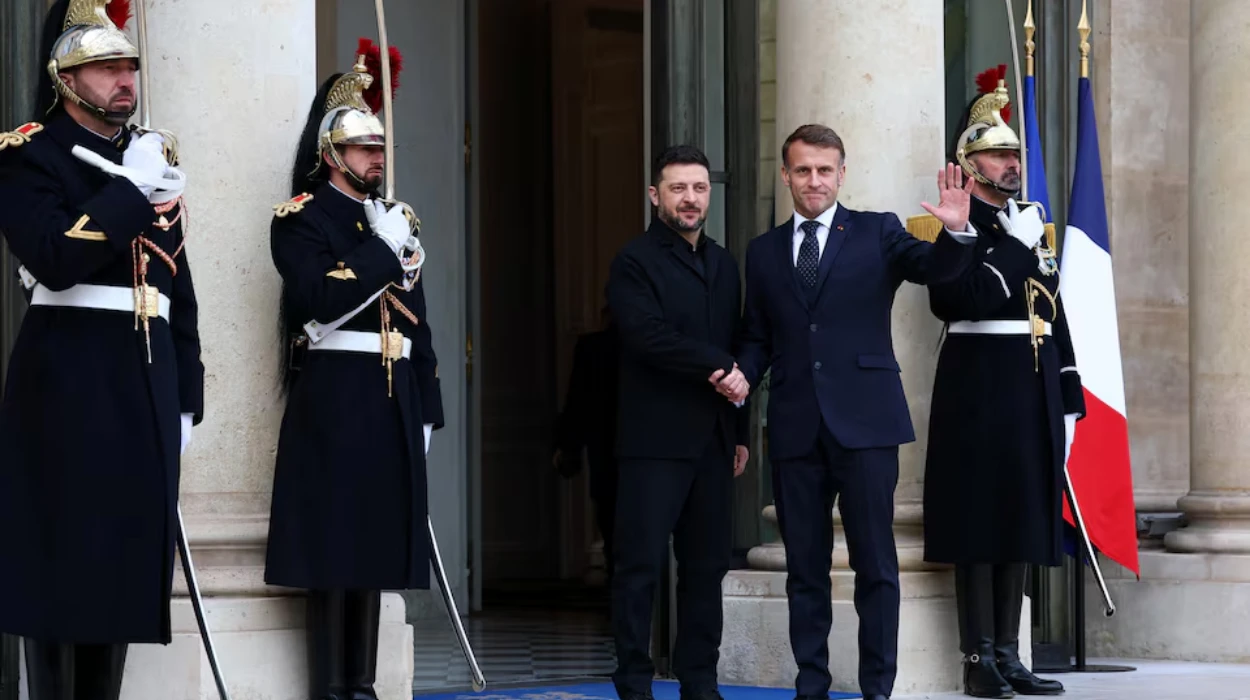
In Paris on Monday, Volodymyr Zelenskiy received support from French President Emmanuel Macron before heading to Ireland on Tuesday, while Ukraine’s defence minister prepared for NATO talks, and Trump envoy Steve Witkoff traveled to Moscow to meet President Putin.
Kyiv and its European allies have called on Washington to revise a U.S. peace plan that initially supported Russia’s key demands, including Ukraine giving up territory, limiting its army, abandoning NATO membership, and barring Western troops.
The French foreign minister, Jean-Noël Barrot, said,
“Peace is within reach, if Vladimir Putin abandons his delusional hope of reconstituting the Soviet empire by first subjugating Ukraine.”
How many civilians have been affected by recent Russian attacks in Ukraine?
The Russian attack on Dnipro overnight killed four people and injured 22, as Moscow maintains its hardline stance along the 1,200 km front.
Moscow claimed its forces captured Klynove and said it is close to taking the ruined city of Pokrovsk. It continued nightly long-range strikes, targeting power stations and leaving residents in cold and darkness.
The Kremlin denounced Ukraine’s long-range strikes hitting a Russian oil terminal and two tankers, aimed at disrupting oil shipments.
The full-scale phase of the Russia-Ukraine war began on February 24, 2022. This conflict is an escalation of a war that started in February 2014.
A June 2025 report cited an assessment of up to 250,000 Russian military deaths and between 60,000 to 100,000 Ukrainian military deaths since the 2022 invasion. For civilians, the UN verified 14,534 deaths between February 2022 and November 2025.