

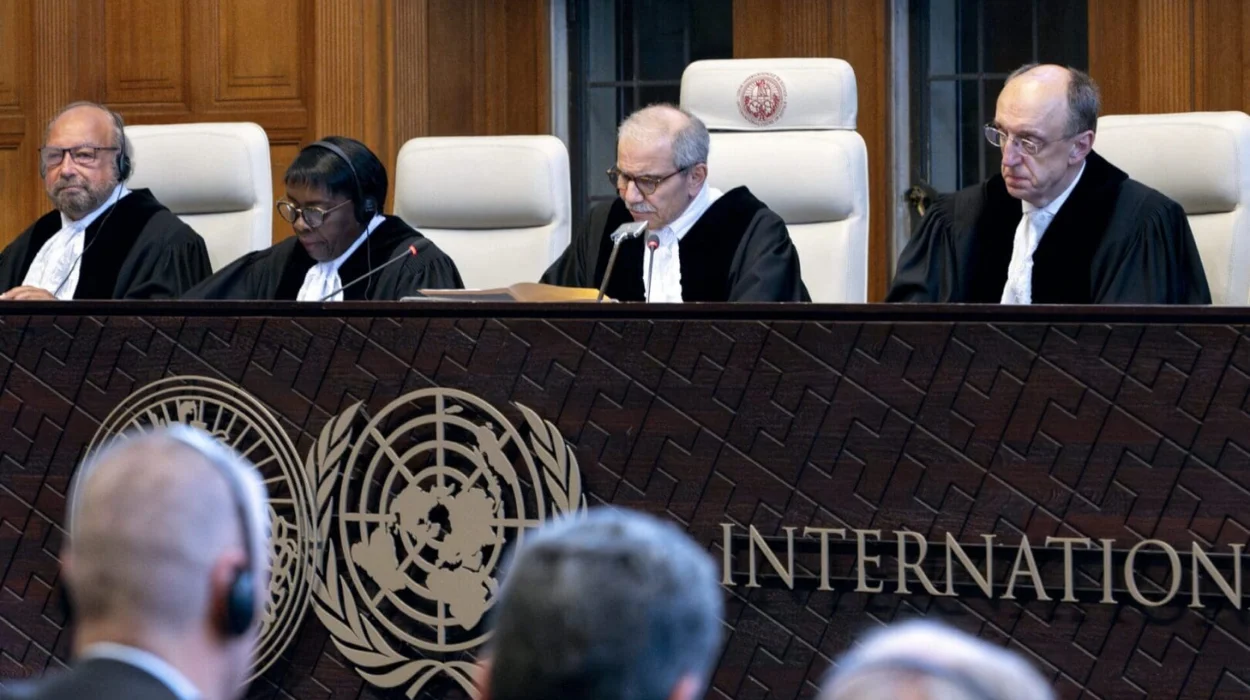
The International Court of Justice (ICJ) ruling on Israel and Palestine, delivered on July 19, 2024, represents a landmark advisory opinion addressing the long-standing legal questions arising from Israel’s occupation of the Palestinian territories, including East Jerusalem. This ruling, requested by the United Nations General Assembly in December 2022, articulates crucial interpretations of international law regarding occupation, self-determination, human rights, and state conduct.
Overview of the ICJ Ruling on Israel-Palestine
The ICJ concluded that Israel’s continued presence in the Palestinian territories occupied since 1967—including the West Bank, East Jerusalem, and Gaza Strip—is unlawful under international law. The Court found Israel responsible for violations including the establishment and expansion of settlements, expropriation and transfer of civilian populations, and enactment of discriminatory legislation altering the demographic composition and status of these territories.
The ruling reaffirmed that such practices contravene the Fourth Geneva Convention and other principles prohibiting the acquisition of territory by force and the denial of peoples’ right to self-determination.
Furthermore, the Court determined that Israel’s policies amount to unlawful annexation efforts and systematic discrimination against the Palestinian population, framing these as serious breaches of international obligations.
By upholding the relevance and application of international humanitarian and human rights law in this context, including treaties such as the CERD (Convention on the Elimination of All Forms of Racial Discrimination), the ICJ emphasized the binding nature of these norms on Israel and all states.
Legal and Political Implications
The ICJ ruling calls for Israel to immediately terminate its occupation, halt settlement activities, dismantle existing settlements, and restore property and rights to displaced Palestinians.
Beyond Israel’s obligations, the Court emphasized that all states and international organisations—including the UN Security Council and General Assembly—are legally bound not to recognize the occupation’s legality, refrain from aiding or assisting Israel in maintaining it, and cooperate in ending this unlawful situation.
Particularly noteworthy is the Court’s rejection of the argument that implementing international law hinges exclusively on bilateral Israeli-Palestinian negotiations. The decision asserts that the obligation to respect international law is not contingent on political processes or agreements.
It also highlights the duty of states to take measures ensuring compliance and preventing the perpetuation of violations.
Contextual Background and ICJ Reasoning
The Court’s advisory opinion draws on extensive historical and legal context, including pivotal UN resolutions dating back to the 1947 Partition Plan and numerous Security Council decisions condemning territorial acquisition by force. It evaluates Israel’s prolonged occupation using principles enshrined in the Hague Regulations and the Fourth Geneva Convention, distinguishing military occupation as temporary and prohibiting sovereignty transfers.
Regarding Gaza, despite Israel’s military withdrawal in 2005, the Court found that Israel retains significant control over the territory’s borders, airspace, and economic access, meaning it remains effectively occupied under international law, a status reinforced by recent security developments.

Key Findings on Settlement Policies and Discriminatory Practices
The ICJ unequivocally affirms that Israel’s settlement policies violate the prohibition on forcible transfer or colonization of occupied territory’s civilian populations. It documents extensive government support and incentives for expanding settlements, including the legalization of unauthorized outposts, contrary to international legal standards.
The Court details the confiscation and requisitioning of land as the foundation of settlement expansion, constituting an illegal appropriation of Palestinian resources.
Moreover, the ruling addresses the systemic discriminatory legal framework that segregates Palestinians and settlers in both physical and judicial senses, breaching provisions of the CERD aimed at eliminating racial segregation and apartheid. This detailed legal analysis underscores the Court’s view of the occupation as characterized by entrenched inequality and a sustained denial of Palestinian rights.
Reactions and Future Prospects
The ICJ ruling has been hailed by Palestinian leaders and international legal scholars as a historic reaffirmation of Palestinian self-determination and an authoritative interpretation of international law. It is viewed as a critical instrument to galvanize global action toward ending the occupation and achieving just peace.
Conversely, Israel has rejected the ruling, viewing it as biased and dismissing the applicability of such legal opinions to its historical and security claims. Some allied states, notably the United States and others, abstained or opposed subsequent UN resolutions reinforcing the ICJ opinion.
The United Nations General Assembly overwhelmingly adopted a non-binding resolution demanding Israel’s withdrawal within one year and urged member states to halt trade and military support linked to the occupation.
The Assembly also mandated Switzerland to convene a conference concerning enforcement of the Fourth Geneva Convention in the occupied territories.
How did the Court interpret Israel’s settlement activities under international law
The International Court of Justice (ICJ) interpreted Israel’s settlement activities in the Occupied Palestinian Territory as violations of international law, specifically breaching the Fourth Geneva Convention. The Court held that the establishment and expansion of settlements, along with the transfer and relocation of Israeli civilian populations into the occupied territories, contravene Article 49, paragraph 6, of the Fourth Geneva Convention, which prohibits an occupying power from deporting or transferring parts of its own civilian population into the territory it occupies.
The Court further noted that Israel’s settlement policy, including the legalization of unauthorized outposts and the confiscation or requisitioning of Palestinian land for settlement expansion, constitutes a systematic breach of its obligations as an occupying power.
These activities fundamentally alter the demographic composition, character, and status of the occupied territories, including East Jerusalem, and undermine the Palestinian people’s right to self-determination. The ICJ concluded that such settlement activities are illegal under customary international law and result in significant legal consequences for Israel, other states, and the United Nations.

Takeaways from the ICJ Ruling on Israel-Palestine
- The Court declared Israel’s prolonged occupation of Palestinian territories unlawful and called for immediate withdrawal and dismantling of settlements.
- Israeli settlement policies and demographic alterations breach international law, including prohibitions against forced population transfers.
- The ruling confirmed obligations of all states to avoid recognizing or supporting the occupation and to cooperate in ending it.
- The Gaza Strip remains considered occupied under international law due to Israel’s control over critical aspects despite military withdrawal.
- The advisory opinion reinforces Palestinian self-determination as a non-negotiable right under international law.
The 2024 ICJ advisory opinion on Israel and Palestine sets a significant precedent in international law by clearly delineating the illegality of Israel’s occupation and settlement activities in the Palestinian territories. It affirms the enduring applicability of fundamental humanitarian and human rights norms, places obligations on all states and international bodies, and strengthens the legal framework underpinning the Palestinian people’s right to self-determination.
While it remains an advisory opinion and not a binding judicial ruling, the ICJ’s conclusions have profound moral, legal, and political ramifications. They provide a foundation for sustained international efforts to resolve one of the world’s most deeply entrenched conflicts according to principles of justice and international law.
