

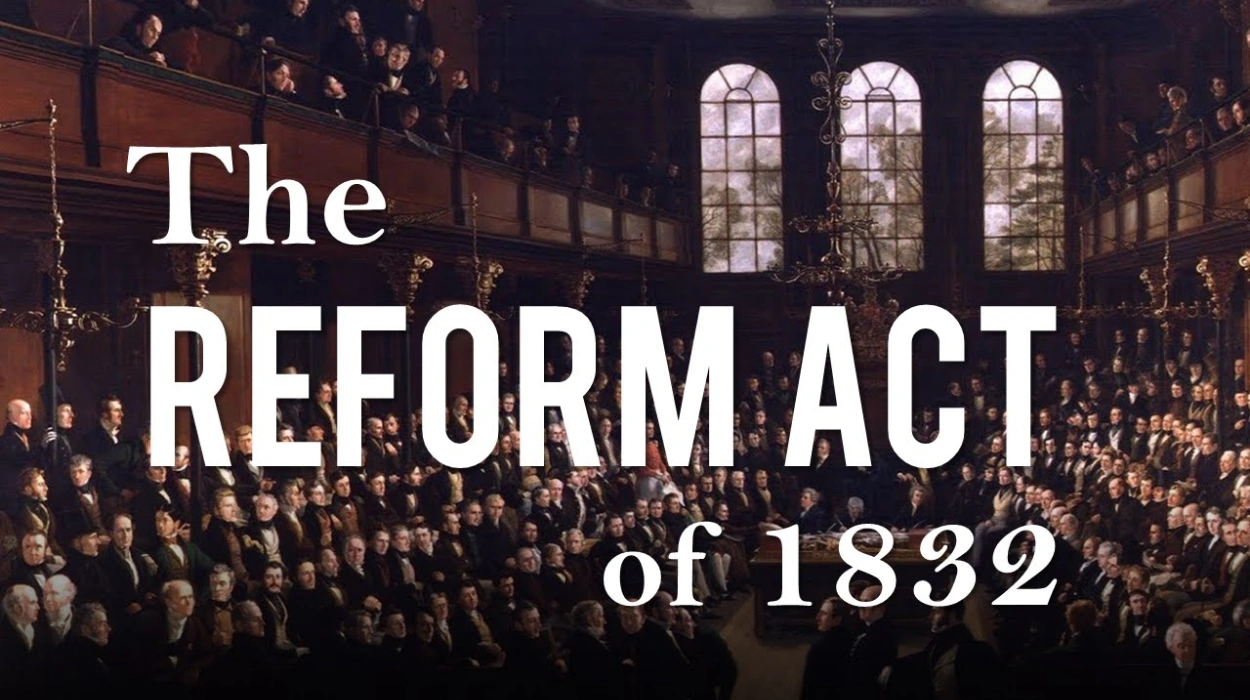
Can you imagine a country where large cities like Birmingham and Manchester had no representation in Parliament? At the same time, deserted villages known as ‘rotten boroughs, had two MPs! This was the case in British politics before 1832. The system was very outdated and stopped representing the experience of a nation that was changing.
The Great Reform Act of 1832 changed everything. It’s one of the most important milestones in British history. But what was the Great Reform Act of 1832, and what did it do? In this article we will explore this piece of legislation in uncomplicated terms and put it in the context of its causes, effects, and subsequent influence.
What Was Wrong With the Old System?
Before we can understand the reform, we have to understand just why the old system was so broken and the way that MPs were elected simply did not make sense to anyone.

The Problem of ‘Rotten’ and ‘Pocket’ Boroughs
Many parliamentary seats or constituencies were mapped on old-time maps, and some places that had been important towns in the Middle Ages were now virtually unoccupied. These were called ‘rotten boroughs.’ The better example was Old Sarum. Old Sarum was a grassy hill with a handful of houses and a few voters. And it returned two MPs to the House of Commons. The new industrial cities were now massive. Manchester, Birmingham, and Leeds didn’t have their own MPs! Their voters had no voice.
But there were other constituencies that were “pocket boroughs.” A rich landowner, often some lord, literally held the seat in his pocket. He could choose who would be the MP, as the voters were his employees, and he told them to do it.
A Very Small Electorate
Voting was limited to a very small percentage of the population. The rules for voting varied across the country but generally were similar: you had to be a man and own land above a certain value. In effect, less than 3% of the population in many parts of the country had the vote. Women could not vote at all. This meant that the majority of people, including the growing middle class of factory owners, bankers, and merchants, had no political power.
Why Did It Happen in 1832?
By the early 1800s, there was intense pressure to change this unfair system. This pressure came from a number of important groups:
- The Middle Class: The wealthy business people and professionals were understandably frustrated. They had money and education but were excluded from politics.
- The Working Class: Ordinary men and women were also angry. They joined mass protests, and the public turned out in droves to demand the right to vote. Many of the ordinary people formed political unions.
- The Whig Party: The Whig politicians aspired to console the voters and saw the situation as irredeemably corrupt. Moreover, the Whig party in almost every district had tens of thousands of voters clamoring for a vote. It was the middle class that gained the right to vote, or they risked a revolution like America’s or France’s. They knew they had to lead the revolution and did their best.
After a massive political struggle, where the king was threatened openly with creating new lords to force the law through, the Great Reform Act was passed in 1832.
What did the Great Reform Act of 1832 actually do?
What were the main fundamental changes this new law brought about? The changes can be broken down into three areas.
1. It Redrew the Political Map of Britain
This was the easiest change. The Act eliminated many of the rotten boroughs. It removed seats from little places like Old Sarum and allocated them to the new industrial cities.
- 56 boroughs were completely removed from the list of constituencies.
- 31 smaller boroughs lost one of their 2 MPs.
The seats saved from these places were given to areas that needed them. Major cities like Manchester, Birmingham, Leeds, and Sheffield gained MPs for the first time. More seats were also created for larger counties to better represent where populations had grown. The House of Commons was more representative of where people lived.
2. It Changed Who Could Vote (But Not Much)
The Reform Act established a uniform rule for voting across the entire country. It expanded the franchise (the right to vote) to further men.
- In towns and cities (boroughs), the vote was to be given to all men who owned or rented accommodation valued at £10 a year or more. That meant richer shopkeepers, factory owners, and merchants.
- In the country (counties), the vote transferred to smaller landowners and farmers.
Importantly, it didn’t enfranchise working-class men or women of any class. The number of people who could vote increased from around 500,000 to 813,000, and this was still only about 18% of adult males. The winners were primarily the middle class.
3. It modernized the Election Procedures
The act also imposed new procedures, making elections a little fairer and less corrupt.
It standardized the process for registering to vote, making electoral rolls more straightforward and clearer.
Bribery and corruption were not eradicated overnight; the act was a first step towards a more regulated and professionalized system.
What Was the Impact and Legacy of the Reform Act?
The Reform Act of 1832 did not create a democracy, but it made a huge impact and led Britain on a new course.
- A Peaceful Step Forward: It proved that large-scale political change could happen through Parliament without a violent revolution. It established a tradition of peaceful reform in Britain.
- It Empowered the Middle Class: The most important immediate effect of the act is that it gave political power to the middle class. Their interests in trade, industry, and economy had a strong voice in Parliament. This would shape laws and policies that would last for the next century.
A Great Leap, But Not the Finish Line
The Great Reform Act of 1832 was a momentous occasion. It did not create an ideal system, but it did address the most serious issues of the previous one. It ended to gave fast-growing cities a political voice, and included the powerful middle class in the political nation. Most notably, it changed the understanding of what Parliament was for. It launched a long shift from a parliament that represented only a handful of wealthy landowners to one that represented and was chosen by the people. It was Britain’s first great step towards democracy.
