
New Delhi (Parliament Politics Megazine) – January 16, 2026 – India and Germany have unveiled a comprehensive joint roadmap for higher education cooperation, focusing on student mobility, research partnerships, and institutional exchanges. The initiative aims to enhance academic ties between the two nations through structured programs and funding mechanisms. Officials from both countries signed a memorandum of understanding to implement the plan over the next five years.
India and Germany announced the joint higher education (HE) roadmap during a virtual bilateral summit hosted by the Indian Ministry of Education and the German Federal Ministry of Education and Research. The agreement builds on existing frameworks like the India-Germany Science & Technology Centre and seeks to double the number of student exchanges by 2030. Education ministers from both nations emphasised the roadmap’s role in fostering innovation and skill development amid global challenges.
The roadmap outlines specific pillars including dual-degree programs, joint PhD supervision, and faculty mobility schemes. It allocates initial funding of €50 million from Germany matched by INR 500 crore from India. Implementation will begin in the 2026-27 academic year, targeting top universities in STEM fields.
Roadmap Details and Key Pillars
The joint HE roadmap comprises five core pillars designed to address gaps in academic collaboration. First, student mobility targets 20,000 exchanges annually by facilitating scholarships and visa simplifications for Master’s and PhD levels. Second, research partnerships prioritise areas like renewable energy, AI, and public health, with joint calls for proposals managed by the Indo-German Science Centre for Mobility (IGSCM).
Third, institutional twinning links 50 Indian institutions with German counterparts, enabling curriculum alignment and credit transfer systems under the European Credit Transfer System (ECTS). Fourth, faculty and researcher exchanges include short-term sabbaticals and co-supervision of theses. Fifth, capacity building focuses on digital infrastructure and quality assurance, incorporating Germany’s accreditation standards.
As reported by Priya Singh of The Times of India, Indian Education Minister Dharmendra Pradhan stated,
“This roadmap marks a new era in India-Germany academic relations, leveraging our demographic dividend and Germany’s technological expertise.”
German Research Minister Bettina Stark-Watzinger echoed this, noting, “Our partnership will drive sustainable innovation for both economies,” according to Markus Schneider of Deutsche Welle.
Historical Context of India-Germany Academic Ties
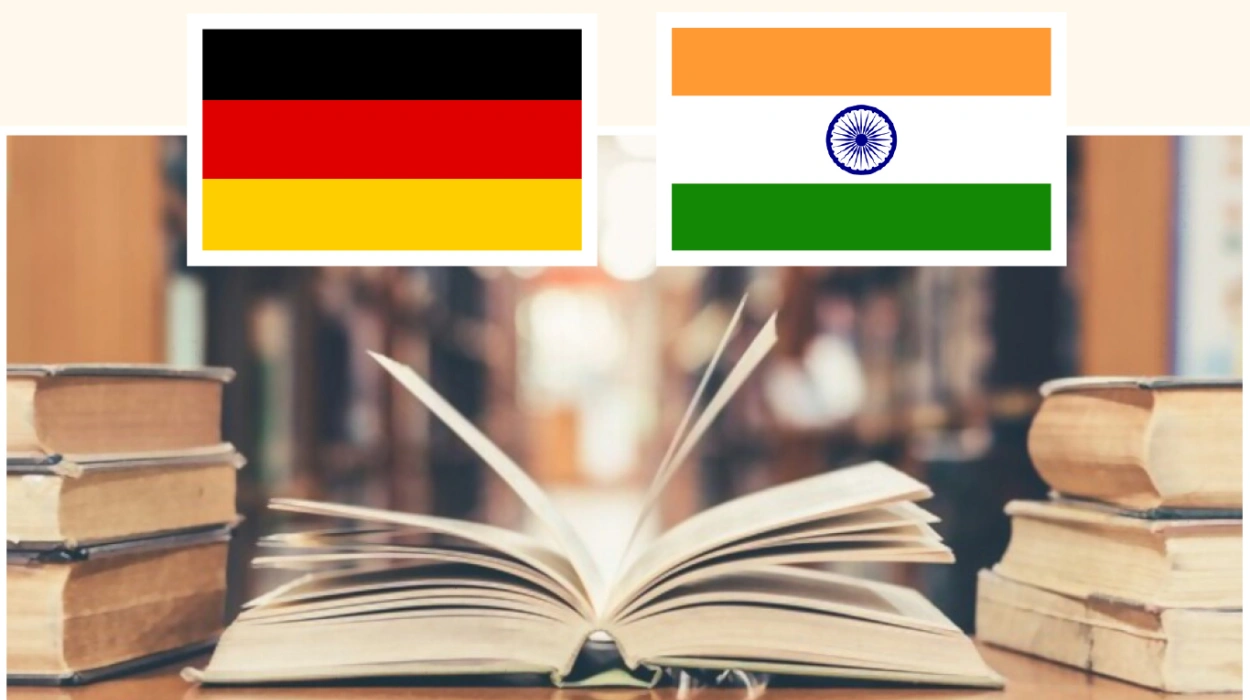
Bilateral education cooperation dates back to the 1970s with the establishment of the Indo-German Project Office. Key milestones include the 2001 launch of the University Cooperation Programme and the 2015 Green Innovation Corridor. The 2022 Virtual Exchange Summit laid groundwork for this roadmap, addressing post-pandemic recovery in higher education.
Prior agreements facilitated over 10,000 Indian students in Germany annually, making it a top destination after the US and UK. Germany offers tuition-free education at public universities, attracting talent from IITs and NITs. India reciprocates through ICCR scholarships for German students.
Data from the German Academic Exchange Service (DAAD) shows a 25% rise in Indian enrolments since 2020, driven by programs like the Helmholtz Association’s PhD fellowships. The roadmap integrates these trends, aiming for balanced flows with more German students to India.
Funding Mechanisms and Implementation Timeline

Funding splits evenly between governments, with private sector contributions encouraged via corporate social responsibility funds. The €50 million German commitment supports 5,000 scholarships, while India’s INR 500 crore funds infrastructure upgrades at 20 partner universities. Annual joint steering committees will monitor progress, reporting to both parliaments.
Implementation phases start with pilot projects in 2026, scaling nationwide by 2028. Visa processing for students reduces to 15 days under mutual recognition agreements. Digital platforms like a shared portal for applications launch in March 2026.
According to Rahul Mehta of Hindustan Times, Pradhan highlighted, “We prioritise employability, ensuring 70% of participants secure industry placements.” Stark-Watzinger added, “Quality assurance through joint audits will uphold global standards,” as per Anna Müller of Frankfurter Allgemeine Zeitung.
Targeted Disciplines and Innovation Focus
STEM disciplines dominate, with 60% allocation to engineering, AI, and climate sciences. Humanities and social sciences receive 20%, emphasising Indo-German cultural studies. Vocational training integrates via dual apprenticeships modelled on Germany’s Ausbildung system.
Joint research hubs in Bengaluru and Munich target quantum computing and biotech. The roadmap aligns with UN Sustainable Development Goal 4 on quality education. Industry partners like Siemens and Tata Group pledge internships for 10,000 students.
Euronews correspondent Lena Vogel reported Stark-Watzinger saying,
“This is not just exchange; it’s co-creation of knowledge.”
Pradhan noted reciprocal benefits, stating, “German expertise strengthens India’s NEP 2020 goals,” per NDTV’s Arjun Patel.
Challenges Addressed and Mutual Benefits
Language barriers prompt German universities to expand English-taught programs, while India boosts Deutsch courses via Goethe-Instituts. Recognition of qualifications follows the Lisbon Recognition Convention. Equity measures reserve 30% spots for women and underrepresented regions.
Benefits for India include skill infusion for Atmanirbhar Bharat; Germany gains diverse talent amid its ageing population. Economic projections estimate €2 billion in R&D value by 2030.
As per BBC’s Sanjay Gupta, DAAD President Professor Joybrato Mukherjee affirmed, “This roadmap operationalises our long-term vision.” Indian Ambassador to Germany Harish Parvathaneni called it “transformative,” according to DW’s reporting.
Stakeholder Reactions and Next Steps
University leaders welcomed the initiative. IIT Delhi Director V. Ramgopal Rao termed it “game-changing” in The Indian Express. RWTH Aachen Rector Ulrich Rüdiger highlighted synergies with existing ties.
Next steps include national workshops in February 2026 and a joint declaration at the G20 Education Working Group. Both nations commit to annual reviews, with mid-term evaluation in 2029.
Reuters’ Arpan Chaturvedi quoted Pradhan:
“We stand committed to measurable outcomes.”
Stark-Watzinger responded,
“Partnership thrives on trust and action,”
solidifying the alliance.
