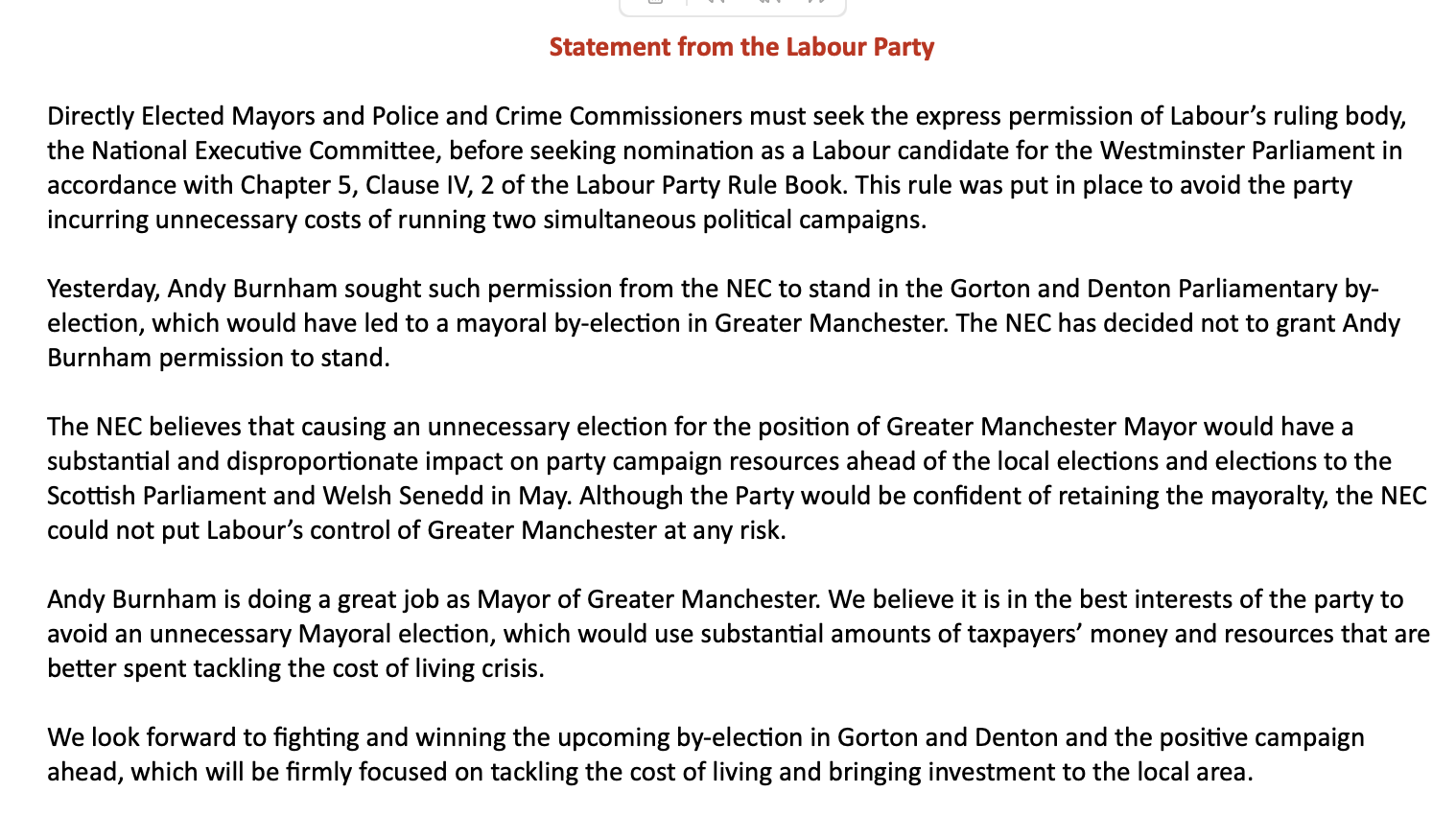
If you thought Labour’s internal squabbles were behind them after their landslide general election victory, think again. The party’s National Executive Committee has just dropped a political bombshell by blocking Greater Manchester Mayor Andy Burnham from standing as Labour’s candidate in the Gorton and Denton by-election. The vote? A decisive 8-1 against. And here’s the kicker: Sir Keir Starmer himself reportedly voted to keep Burnham out of Westminster.
Grab your popcorn, folks. This one’s getting messy.
The Background: A Seat Up for Grabs
The Gorton and Denton constituency became available after Andrew Gwynne resigned from Parliament following a scandal involving inappropriate messages. It’s a safe Labour seat in Greater Manchester: Burnham’s own backyard and political stomping ground.
For Burnham, this seemed like the perfect opportunity. The former Health Secretary and two-time Labour leadership contender has been serving as Greater Manchester’s mayor since 2017, building a reputation as a straight-talking, media-savvy politician who isn’t afraid to challenge the party leadership when he thinks they’ve got it wrong.
And that, it seems, might be precisely the problem.
The NEC Decision: 8-1 Against
Labour’s ruling body, the NEC, has a little-known rule that requires sitting mayors to seek permission before standing for Parliament. It’s designed to prevent chaos: after all, if a mayor wins a parliamentary seat, you’re looking at triggering another expensive by-election to replace them.
But the manner of this decision has raised eyebrows across the party. The NEC’s “officers’ group” voted overwhelmingly to block Burnham, with only Lucy Powell: the Leader of the House of Commons and a fellow Greater Manchester MP: voting in his favour.
The official justification? Money and practicality. Labour sources claim that running two by-elections (one for Parliament, one for mayor) would cost approximately £1.5 million. In times of tight budgets and political belt-tightening, that’s apparently a luxury the party can’t afford.
There was also talk of implementing an all-women shortlist for the seat, given Labour’s current gender imbalance among MPs. A convenient argument, perhaps, but one that arrived rather late in the day.
The Real Reason – Leadership Paranoia?
Let’s be honest here. The cost argument might hold some water, but it’s hard to ignore the elephant in the room: Andy Burnham is seen by many as the most credible alternative to Keir Starmer should things go south.
Cast your mind back to September 2025. Starmer’s leadership was facing intense scrutiny following the Angela Rayner tax scandal and a series of controversial cabinet reshuffles. Polls at the time painted a troubling picture for the Prime Minister. A YouGov/Sky News survey found that a staggering 62% of Labour members would back Burnham over Starmer in a hypothetical leadership contest.
That’s not the kind of statistic that helps you sleep at night if you’re sitting in Number 10.
Burnham, for his part, has insisted he has no intention of challenging Starmer. He’s repeatedly stated that he wants to return to Parliament to “support” the government and contribute from within. But in politics, actions speak louder than words: and the NEC’s actions suggest they’re not entirely convinced.
The Backlash: Labour’s Big Names Speak Out
If Starmer and his allies hoped this decision would quietly disappear from the headlines, they were sorely mistaken. The blocking has triggered a remarkable public display of dissent from some of Labour’s most prominent figures.
Deputy Prime Minister Angela Rayner publicly backed Burnham’s candidacy, as did former Labour leader Ed Miliband. London Mayor Sadiq Khan weighed in too, arguing that local party members should have the final say on their candidate.
Lucy Powell, the sole voice of support on the NEC committee, described Burnham as “an incredibly popular politician” who would be an asset to the parliamentary party. Former shadow chancellor John McDonnell went further, warning that blocking Burnham “would cause immense damage both to Keir and therefore the party.”
These aren’t backbench rebels or fringe figures. These are cabinet ministers and party grandees openly criticising a decision that the Prime Minister himself endorsed. It’s the kind of public division that opposition parties dream about.
Burnham’s Response: Dignified but Disappointed
Andy Burnham has responded to the decision with characteristic restraint, though his disappointment is palpable. He’s made clear that he believes local members should have had the opportunity to decide, and that the NEC’s intervention undermines the democratic processes the party claims to champion.
It’s a clever line of attack. Labour has long positioned itself as the party of grassroots democracy and member empowerment. Blocking a popular candidate without giving local activists a say sits awkwardly with that image.
There’s also the question of what happens next for Burnham. His current term as Greater Manchester Mayor runs until 2028. Does he now settle in for the long haul, building his regional power base while waiting for another opportunity? Or does this decision mark the beginning of a more openly fractious relationship with the national leadership?
The Broader Context: Cracks in the Coalition
This isn’t happening in isolation. Labour’s commanding parliamentary majority masks some significant internal tensions. The party’s big-tent coalition: spanning everything from urban progressives to traditional working-class voters, from Corbyn-era activists to returning Blairites: was always going to be difficult to hold together.
Recent months have seen grumbling about the government’s direction on everything from economic policy to civil liberties. The Rayner tax affair damaged trust at the top. And now this very public slap-down of one of the party’s most recognisable and popular figures threatens to pour petrol on smouldering resentments.
The accusation of “nasty factionalism” has already been levelled at the leadership. For a party that promised to end the chaos and division of the Johnson/Truss/Sunak years, it’s not a good look and expect the opposition parties to take aim at this rather large and painful bruise over coming weeks.
The Cost of Unity: Or the Lack of It
Ironically, Labour’s justification for blocking Burnham centred on costs. But the political cost of this decision may prove far higher than any by-election expense.
The party has handed its opponents a ready-made narrative: Labour talks about democracy but won’t let its own members choose their candidates. It claims to welcome talent but blocks anyone who might pose a future threat. It preaches unity but practices control.
Whether that narrative is fair or not is almost beside the point. In politics, perception matters. And right now, the perception is of a leadership team more concerned with protecting its position than with building the strongest possible parliamentary party.
What Does This Mean for Sir Keir Starmer and Party Unity?
And so we arrive at the question that will dominate Labour circles for weeks to come.
Has Starmer made a shrewd political calculation, neutralising a potential rival before he becomes a genuine threat? Or has he made a catastrophic error, alienating a popular figure and exposing the authoritarian tendencies that his critics have long warned about?
The answer probably depends on what happens next. If Labour’s poll numbers start to rise and the government delivers on its key promises, this will become a footnote: a brief moment of internal drama quickly forgotten. But if things do not improve, if the economy continues to falter or scandals mount, then Burnham’s blocking will be remembered as the moment Starmer made an enemy he couldn’t afford.
For now, the Greater Manchester Mayor remains outside Westminster, watching from the sidelines. But in politics, nothing is ever truly settled and keeping Burnham out of Westminster could prove to be a costly mistake. Worth noting that Burnham has also proven before that he’s more than capable of playing the long game. Being the Mayor of Manchester and not part of the Government has allowed to keep clear of the unpopularity of Sir Keir’s administration, while still enjoying a national platform.
And then as one Labour figure said to me last week: “The key question is – for how long can Keir Starmer afford to keep looking over his shoulder? Burnham is just one of the potential rivals to his crown, there are many more already in Parliament.”
Breaking: Andy Burnham blocked from standing as Labour candidate in Gorton and Denton by-election