

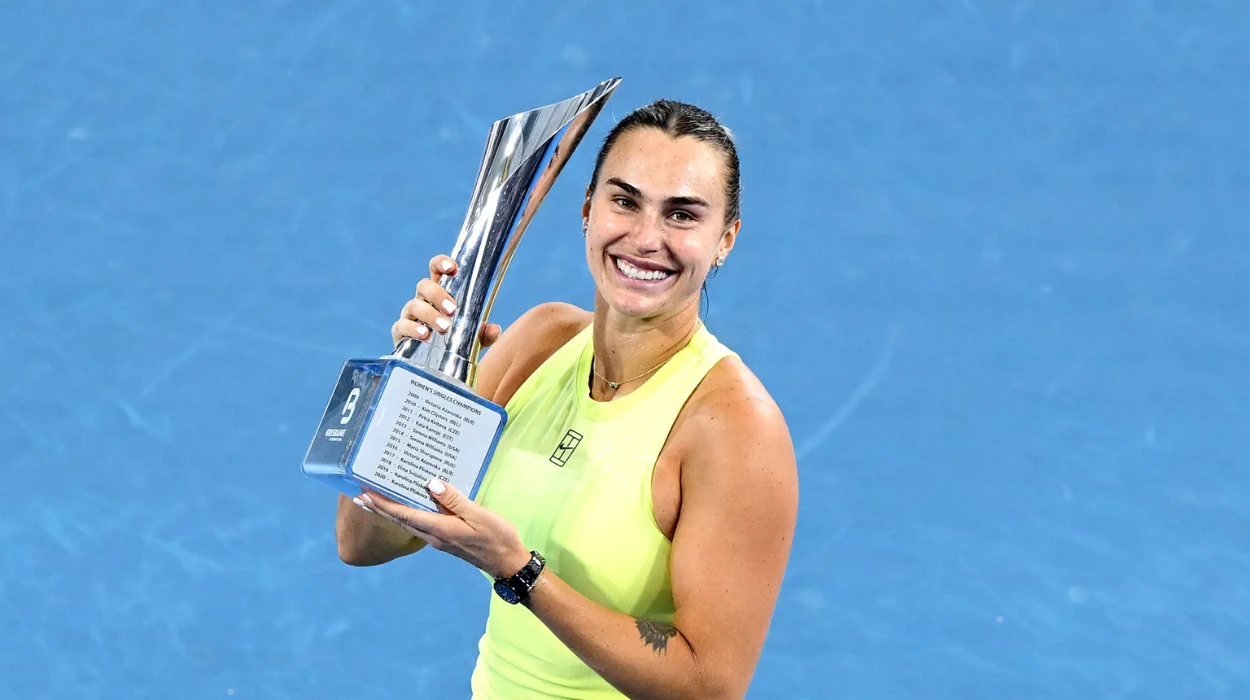
Melbourne (Parliament Politics Magazine) January 18, 2026 – Aryna Sabalenka, the world number one and two-time defending champion, delivered a composed straight-sets victory over France’s qualifier Tiantsoa Rakotomanga Rajaonah in the first round of the 2026 Australian Open. The Belarusian prevailed 6-4, 6-1 on Rod Laver Arena, converting five of eight break points in a 92-minute encounter marked by powerful serving and clutch play. Sabalenka fired 28 winners and committed just 19 unforced errors, extending her flawless first-round record at the tournament to eight matches.
The match showcased Sabalenka’s signature aggression under Melbourne’s midday sun, with temperatures reaching 29 degrees Celsius. Rakotomanga Rajaonah mounted a spirited fightback in the first set but faltered at critical junctures, handing the top seed a solid platform for another deep run.
Sabalenka’s Commanding Start on Centre Court

Play commenced at 1:00 PM local time on Rod Laver Arena, the spiritual home of the Australian Open since its naming in 2000. Sabalenka, entering with a 26-match winning streak at majors dating back to the 2024 US Open semi-finals, wasted no time asserting dominance. Her first serve, clocked at up to 120 mph, proved impenetrable early on, as she held to love in the opening game with two aces.
Rakotomanga Rajaonah, ranked 188th who navigated three qualifying wins, faced immediate pressure. In the third game, Sabalenka earned break point after the Frenchwoman netted a forehand, and a double fault gifted the Belarusian a 2-1 lead. Sabalenka consolidated with a hold featuring four winners, including a crosscourt backhand that kissed the line.
As reported by Jamie Nesbitt of BBC Sport, Sabalenka reflected post-match,
“The conditions felt perfect for my game today. She served big and made me work, but I executed my plan well.”
The first set concluded in 38 minutes when Rakotomanga Rajaonah overhauled a backhand long on break point in game nine, with Sabalenka celebrating by pumping her fist to the appreciative crowd of 15,000.
Statistical edges underscored the top seed’s control: 71% first-serve points won to Rakotomanga Rajaonah’s 58%, and 5 aces against 3 double faults. The Frenchwoman’s 22 unforced errors contrasted Sabalenka’s efficient shot-making.
Tennis journalist José Morgado highlighted Sabalenka’s strong opening performance on social media. José Morgado (@josemorgado) said in X post,
“World #1 and two-time champ Aryna Sabalenka starts her 2026 #AusOpen campaign with a good 6-4, 6-1 win over Sarah Rakotomanga 6-4, 6-1. Improves to 29-6 at Melbourne Park. Awaits Pavlyuchenkova or Bai next.”
World #1 and two-time champ Aryna Sabalenka starts her 2026 #AusOpen campaign with a good 6-4, 6-1 win over Sarah Rakotomanga 6-4, 6-1.
Improves to 29-6 at Melbourne Park.
Awaits Pavlyuchenkova or Bai next. pic.twitter.com/Se0zdJzi4Q
— José Morgado (@josemorgado) January 18, 2026
Second Set Drama as Rakotomanga Rajaonah Forces Early Resistance
Momentum shifted briefly in the second set, where Rakotomanga Rajaonah adopted a higher-risk approach, stepping inside the baseline to neutralise Sabalenka’s power. The Frenchwoman held from 0-30 in game one and broke at 2-2 when Sabalenka’s volley sailed wide after a 12-shot rally. Rakotomanga Rajaonah levelled at 2-2, her serve peaking at 112 mph to save a break-back point.
Sabalenka broke straight back in game five, inducing an error on Rakotomanga Rajaonah’s forehand with deep returns. Holds alternated until the set opened up, where Sabalenka pulled away decisively. Courtney Nguyen of ESPN Tennis noted,
“Sabalenka’s ability to reset after concessions has defined her recent major success, evident in those final games.”
The Belarusian ended with 28 winners to 19, a 75% second-serve points won rate, and no breaks conceded after the early lapse. She awaits the winner of Anastasia Pavlyuchenkova versus Zhuoxuan Bai in round two.
Origins and Evolution of the Australian Open Tournament
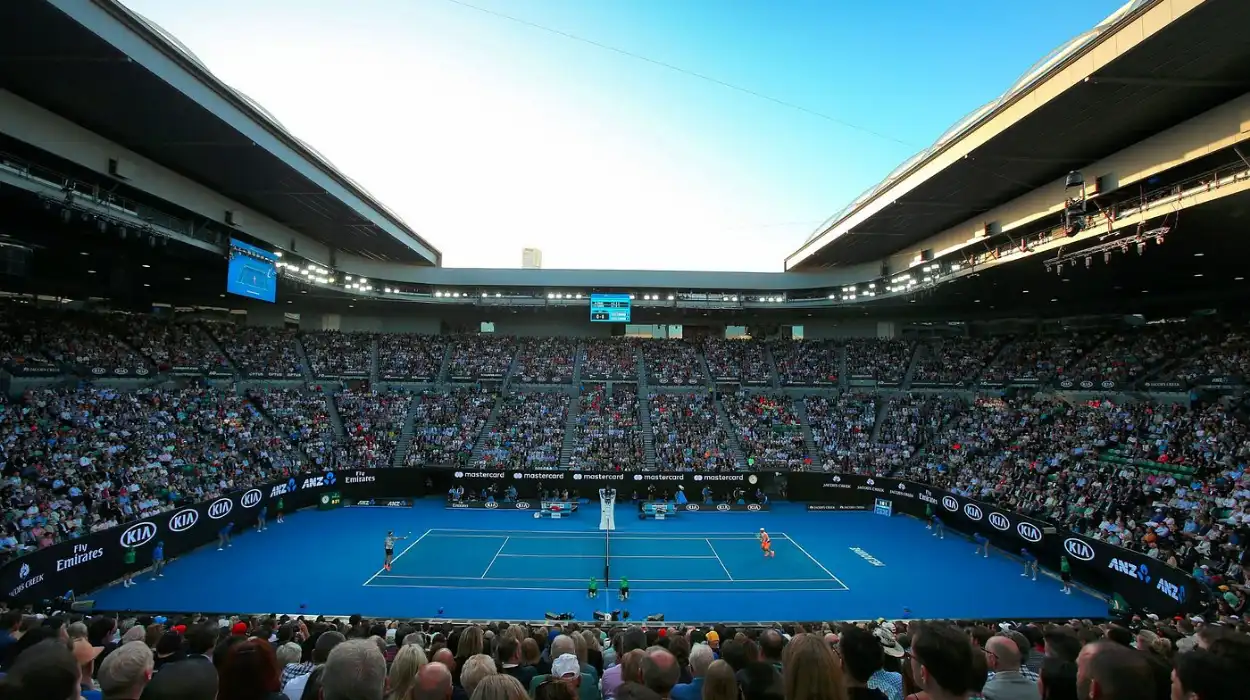
The Australian Open traces its roots to 1905, when it debuted as the Australasian Championships at Warehousemen’s Cricket Ground in Melbourne. Organised by the Lawn Tennis Association of Australasia, it featured just 17 men and 6 women, with Australian Rodney Heath claiming the inaugural men’s title over compatriot Harry Parker.
Relocated multiple times—Albert Ground in 1908, Kooyong Lawn Tennis Club from 1927—the event expanded post-World War II amid debates over its geographic isolation. The professional Open Era began in 1969 at White City Stadium, Sydney, with Margaret Court defeating Billie Jean King 7-9, 7-5, 6-1 for her fourth Melbourne crown.
Green-set Rebound Ace arrived in 1988 at Melbourne Park (formerly Flinders Park), boosting speed and bounce. A shift to medium-fast Plexicushion hard courts occurred in 2008, favouring baseline power akin to Sabalenka’s style. Capacity grew from 8,000 at Kooyong to over 40,000 today across 39 courts, including the 15,000-seat Rod Laver Arena opened in 1988 and refurbished in 2019.
Notable milestones include the 1977 equal prize money introduction—first among Grand Slams—and night sessions from 1982.
Attendance surpassed 1 million in 2019, recovering post-COVID to 979,000 in 2025. Prize money hit AUD 106.6 million for 2026, with champions earning AUD 3.15 million.
Rod Laver, the arena’s namesake, won 11 majors, including calendar Grand Slams in 1962 (amateur) and 1969 (Open Era). Margaret Court leads with 24 Slams, 11 at Melbourne; Roy Emerson holds men’s venue honours with six.
Historical Champions and Women’s Draw Legacy
Women’s champions reflect the tournament’s evolution. Court dominated the pre-Open Era with 11 titles (1960-1973). Post-1968, Evonne Goolagong Cawley won four (1974-1976, 1980), followed by Chris Evert (1982, 1984), Steffi Graf (1988-1990, 1994), and Monica Seles (1991-1993, 1996).
The 2000s saw Serena Williams’ seven triumphs (2003, 2005, 2007, 2015, 2017, 2019, 2021 partial), with Justine Henin (2004), Maria Sharapova (2008), and Victoria Azarenka (2012, 2013) adding lustre. Naomi Osaka defended in 2019-2021 before Angelique Kerber (2019 partial), Sofia Kenin (2020), and Naomi Osaka again.
Sabalenka joins an elite defending list since 2000: Davenport (2000), Williams multiple times, Azarenka (2013), Osaka (2019). Her 2024 final rout of Zheng Qinwen (6-3, 6-2) and 2025 win over Coco Gauff (7-6, 6-4) mark her as the first back-to-back-to-back finalist since Williams in 2017.
The 2026 draw pits top seed Iga Swiatek against Rebecca Sramkova, with second seed Coco Gauff facing qualifier Maja Chwalinska. Third seed Jessica Pegula beat Ashlyn Krueger 6-4, 6-3; fourth Mirra Andreeva outlasted Mayar Sherif 4-6, 6-3, 6-2.
Post-match, tennis writer Matt Trollope provided statistical context on Sabalenka’s impressive form at the event. Matt Trollope (@MattyAT) said in X post,
“With her 6-4 6-1 win just now in her opening match of #AO2026, Aryna Sabalenka has won 43 of her past 47 sets at the Australian Open, and 21 of her past 22 matches.”
With her 6-4 6-1 win just now in her opening match of #AO2026, Aryna Sabalenka has won 43 of her past 47 sets at the Australian Open, and 21 of her past 22 matches.
— Matt Trollope (@MattyAT) January 18, 2026
Men’s Draw Highlights and Tournament Logistics
Men’s action featured world number one Carlos Alcaraz facing home hope Adam Walton on Rod Laver Arena. Second seed Alexander Zverev overpowered Gabriel Diallo 6-7(1), 6-1, 6-4, 6-2; third Jannik Sinner awaits a qualifier.
Fifth seed Jack Draper of Britain prevailed 7-6, 6-4, 6-3 over Thiago Tirante, boosting UK hopes alongside sixth seed Emma Raducanu’s opener against Mananchaya Sawangkaew. Qualifying injected 16 players per draw, with wild cards to Australians like Alexei Popyrin.
Tournament director Craig Tiley reported day one attendance of 92,000, nearing capacity. Sessions run 11 AM-11 PM, with free public transport for ticket-holders. Sustainability efforts include 100% LED lighting and zero-waste goals.
Broadcast partners—Eurosport (Europe), beIN Sports (MENA), Tennis Channel (US)—reach 200 territories. Qualifying spanned 18-20 January, main draw 12-25 January across 14 day-sessions.
Sabalenka’s Pre-Tournament Preparation and Record
Sabalenka entered 2026 with a 45-7 seasonal record, capped by WTA Finals victory over Gauff in Cancun. She bypassed Adelaide, opting for Brisbane hit-outs where she dropped just 18 games across four wins.
Head-to-head with Rakotomanga Rajaonah stands at 1-0 now. Coach Anton Dubrov emphasised fitness gains, addressing past cramping issues.
Simon Briggs of The Telegraph observed,
“Sabalenka’s serve-return combo, honed in off-season, renders her formidable on Plexicushion.”
Her Australian Open stats: 29-6 lifetime, never exiting before quarters.
Next challenges loom with Pavlyuchenkova (2025 quarter-finalist) or Bai, setting a quarter-final course through Pegula or Barbora Krejcikova.
Broader Context and Future Outlook
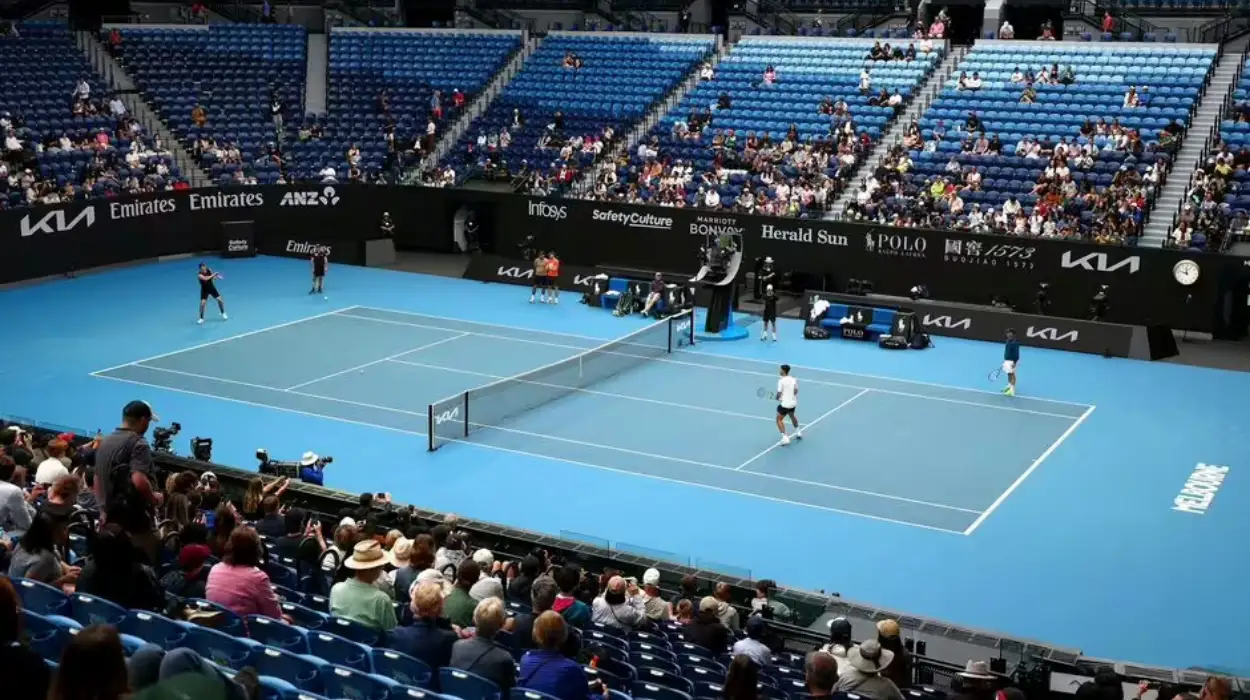
The Open’s night sessions feature prime-time clashes like Djokovic versus qualifier on 1573 Arena. Doubles start Tuesday, mixed Thursday. Fan zones offer interactive exhibits, including Laver’s trophy cabinet.
Historical upsets—Lleyton Hewitt’s 2005 exit, Jelena Dokic’s 2000-2002 runs—remind of volatility. Sabalenka’s opener, however, signals continuity for the power era.
Play resumes Monday with 32 singles matches daily, culminating in a men’s final on 25 January and women’s on 24th.
Australian Open 2026 Schedule
The 2026 Australian Open runs from Sunday 18 January to Sunday 1 February, featuring a packed calendar of singles, doubles, and junior events as detailed by Jamie Braidwood of The Independent.
Day One – Sunday 18 January (16 x men’s singles and 16 x women’s singles | first round)
Key matches included Jasmine Paolini def. Aliaksandra Sasnovich 6-1, 6-2; Alexander Zverev def. Gabriel Diallo 6-7(1), 6-1, 6-4, 6-2 on Rod Laver Arena. Upcoming: Aryna Sabalenka vs. Tiantsoa Rakotomanga Rajaonah; Carlos Alcaraz vs. Adam Walton.
Day Two – Monday 19 January (28 x men’s singles and 28 x women’s singles | first round)
Rod Laver: Coco Gauff vs. Kamilla Rakhimova; Iga Świątek vs. Yue Yuan; Novak Djokovic vs. Pedro Martínez.
Tournament Overview
- Tuesday 20 January: 20 singles first round + doubles first round.
- Wednesday 21 January: Second round singles + doubles.
- Thursday 22 January: Second round continuation.
- Friday 23 January: Third round singles + doubles second round + mixed first round.
- Saturday 24 January: Third round + doubles + mixed + juniors first round (women’s final day noted in prior context).
- Sunday 25 January: Fourth round + doubles third + mixed second + juniors.
- Subsequent days progress to quarter-finals (27-28 Jan), semi-finals (29-30 Jan), with finals: Women’s singles Saturday 31 January, Men’s Sunday 1 February.
Full order of play available across arenas including Margaret Court, John Cain, KIA, 1573, and outer courts.
