

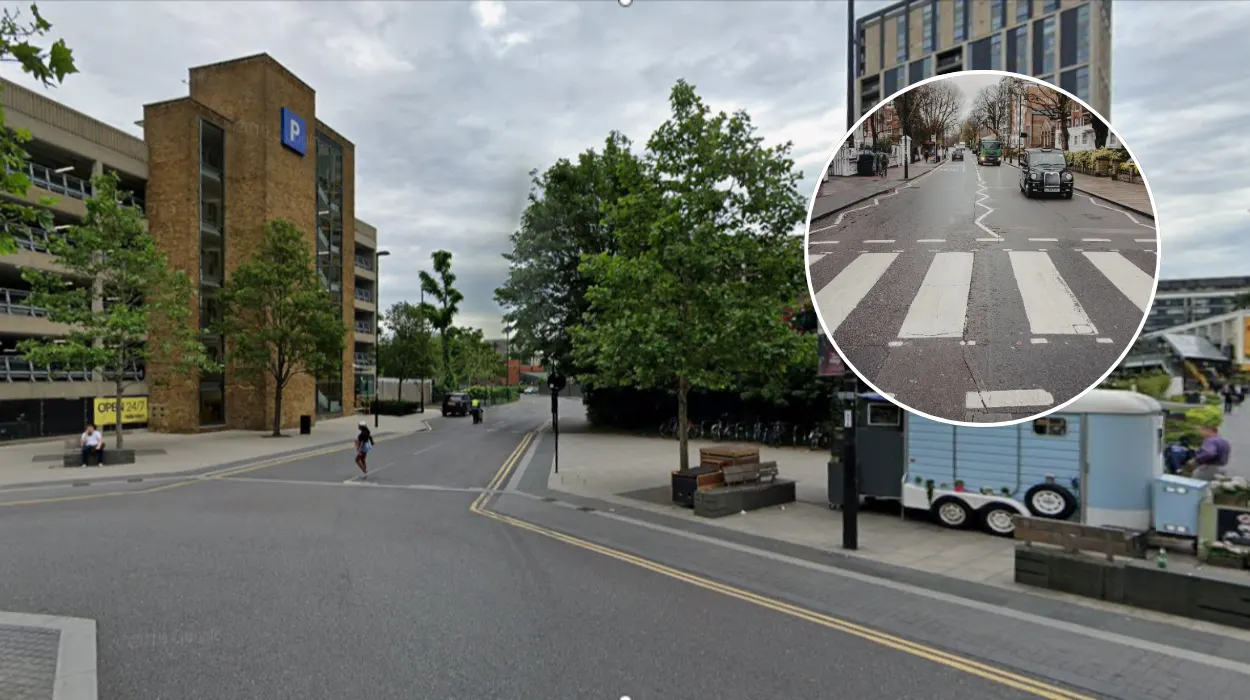
Croydon (Parliament Politics Magazine) – Croydon has opened a new pedestrian crossing to bridge a long-standing “missing link,” reconnecting areas divided by a road that once split the town.
The new Wellesley Road crossing opened this morning (Wednesday, December 3), with Mayor Jason Perry calling it the “final missing link” in reconnecting a road that had “split the town in half for years”. Speaking to the Local Democracy Reporting Service (LDRS), he claimed Croydon is “proudly reconnecting” itself by completing a path from East Croydon station to the Whitgift Centre and to North End.
Mayor Perry told the LDRS the crossing is “a key piece of infrastructure, delivered on time,” completing a loop alongside earlier crossings near West Croydon and Fairfield Halls. He said that the scheme was complicated due to the tram line but achieved in a short window thanks to coordinated work between the council, TfL and contractors.
Work on the street-level crossing began in July after Croydon Council secured £30m to refurbish the town centre. By connecting East Croydon to the main commercial district, the new layout, according to the council, would help companies and be completed in time for the Christmas season.
At this morning’s opening celebration, attended by councillors, TfL, FM Conway and council executives, Jason Perry cut a purple ribbon with large scissors and was the first to cross alongside Cabinet Member for Streets and Environment Scott Roche. The rebuilt crossing incorporates tactile paving and disability-accessible lights, with wayfinding signage still to be placed.
Landscaper Matthew Perry from Croydon Place stated 15 additional trees have been placed along the crossing, with easy to maintain wildflower turf to adhere to. He emphasized that the trees must stay modest with thin canopies due to the proximity of the tram line.
Contractors from FM Conway, who directed construction of the toucan crossing, said that the greatest difficulty was “attempting to keep everything going, as we had buses, trams, pedestrians and trams”. They indicated that tram moves along the busy route were handled using “manually operated lights by operatives day and night.”
Green councillor Ria Patel said the bridge is a significant improvement for her Fairfield district, particularly after the underpass closure posed access problems for Whitgift companies. She claimed it had been “frustrating” since some shops lost disability access and fire escapes when the tunnel was sealed.
Councillor Patel stated that people routinely crossed Wellesley Road dangerously even before the underpass closed.
“So hopefully we won’t now see people jumping across the road,”
she remarked.
The 1960s-built underpass, which was closed last year due to fire damage connected to antisocial behavior, is replaced by the new crossing. The underpass was filled with polystyrene blocks and concrete over the summer and will shortly be paved over to create greater room for pedestrians.
Across town, the municipality will shortly fill up the underpass linking the Old Town to St John’s Road as part of works around Croydon Minster. Perry told the LDRS:
“Ultimately I would like to see the subways removed as we replace them with crossings.”
The Wellesley Road plan brought £4 million and was funded through a variety of sources, including the Growth Zone, TfL’s Original perpetration Plan, an remuneration agreement, and the government’s Levelling Up Fund. It’s part of a larger package of advancements funded by the council’s£ 18.5 million Levelling Up Fund entitlement for public realm and thruway upgrades in the city centre.
The focus now shifts to Dingwall Road, where work will ameliorate kerbs, footways, cycle lanes, and add central dividing islets between Lansdowne Road and George Street.
Mayor Perry told the LDRS:
“Basically it is a very confused junction at the moment and people don’t know where they are going. It is a case of reorganising that so it is fluid and there is no blockage.”
West-side work began on November 20 and is expected to last about ten weeks, with east-side closures beginning on January 6, 2026, for four weeks. A full carriageway closure is planned for approximately two weeks beginning February 9, 2026, with orders in force for up to 18 months if more work is required.
Traffic and parking will be restricted, with general traffic redirected via Sydenham Road, Wellesley Road, Croydon Underpass, Park Lane, and the Fairfield Roundabout. Cyclists will use a different diversion and must dismount during footway closures, while pedestrians, emergency services, and contractors will continue to have access.
How does the new crossing improve accessibility for disabled users?
The crossing creates safer and easier access between East Croydon and the city centre, supporting Croydon’s ongoing city centre rejuvenation. Level, step-free access on all approaches, barring walls for wheelchair druggies and those with mobility impairments. Tactile paving and audio signals at crossing points to prop visually bloodied climbers.
Wider pathways and clear signage enhancing navigation and safety for people using mobility aids. Reduced crossing distances and business calming measures to lower threat and stress for vulnerable druggies. bettered lighting for better visibility during low- light conditions.
These features support inclusive mobility harmonious with ultramodern availability norms, enabling impaired druggies to move across the busy road safely and singly, reconnecting the preliminarily divided corridor of the city.