France (Parliament Politics Magazine) – UK backs 27 European nations to limit human rights laws, enabling Rwanda-style migration deals and expanded deportation powers.
As reported by The Guardian, Britain has joined several European nations in calling for limits on human rights laws to allow Rwanda-style migration deals and increased deportations.
How are 27 European countries seeking to change human rights rules for migrants?
The UK, Hungary, Italy, and 24 other Council of Europe members have supported an unofficial statement calling for a new framework for the European Convention on Human Rights, which would narrow the scope of
“inhuman and degrading treatment.”
The statement comes after a Council of Europe meeting in Strasbourg on Wednesday, in an effort to reshape how laws are applied in migration cases.
At the meeting, UK Deputy Prime Minister David Lammy was expected to argue that existing rules must not prevent countries from acting against illegal migration.
Among the countries refusing to support the informal statement were France, Spain, and Italy, which signed a separate, official declaration endorsed by all 46 Council of Europe members.
The existence of two separate statements highlights deep divisions across Europe over how to manage irregular migration and protect the rights of refugees and economic migrants.
According to the letter signed by 27 countries, Article 3 of the convention, which bans “inhuman or degrading treatment,” should be
“constrained to the most serious issues in a manner that does not prevent states from taking proportionate decisions on the expulsion of foreign criminals, including in cases involving healthcare and prison conditions.”
The letter also proposes changes to Article 8, giving greater weight to the seriousness of a crime over a criminal’s personal or family ties in the host country.
In a reference to deals with third countries prepared to take in rejected asylum seekers, the statement adds,
“A sate party should not be prevented from entering into cooperation with third countries regarding asylum and return procedures, once the human rights of irregular migrants are preserved.”
The remaining signatories among the 27 countries include Denmark, Albania, Austria, Belgium, Bulgaria, Croatia, the Czech Republic, Estonia, Finland, Iceland, Ireland, Latvia, Lithuania, Malta, Montenegro, the Netherlands, Norway, Poland, Romania, San Marino, Serbia, Slovakia, Sweden, and Ukraine.
The official statement, supported by all member states, does not raise any issues with specific articles of the convention.
The head of the body overseeing the ECHR said ministers had taken an important step by agreeing on a political declaration on migration and backing measures to tackle migrant smuggling with full human rights protections.
What did Alain Berset say about migration and human rights?
The Council of Europe secretary general, Alain Berset, said,
“All 46 member states have reaffirmed their deep and abiding commitment to both the European convention on human rights and the European court of human rights.”
He added,
“This is not rhetoric. This is a political decision of the highest order. But ministers have also expressed their concerns regarding the unprecedented challenges posed by migration and the serious questions governments face in maintaining societies that deliver for citizens.”
How did Keir Starmer and Mette Frederiksen describe the need to reform asylum systems?
UK Prime Minister Sir Keir Starmer and Danish counterpart Mette Frederiksen said the current asylum framework was “created for another era,” warning that
“yesterday’s answers do not work. We will always protect those fleeing war and terror – but the world has changed and asylum systems must change with it.”
The Labour leader has adopted a series of tough immigration measures, inspired by Denmark’s centre-left government under Mette Frederiksen, aimed at reducing the number of migrants crossing the English Channel.
Both leaders said,
“Together, we are calling on our friends across Europe to go further in tackling these shared challenges. Nations arguing for reform hope a political declaration signed by the gathered ministers in Strasbourg could carry enough weight to directly influence how the European Court of Human Rights interprets the agreement.”
They added,
“Europe has faced big tests before and we have overcome them by acting together. Now we must do so again. Otherwise, the forces that seek to divide us will grow stronger. So our message is this: as responsible, progressive governments we will deliver the change that people are crying out for. We will control our borders to protect our democracies – and make our nations stronger than ever in the years to come.”
What did Steve Valdez-Symonds say about UK Rights and Human Rights Day?
Steve Valdez-Symonds, Amnesty International UK’s refugee and migrant rights programme director, said,
“There is a dreadful irony in our Justice Secretary working with his counterparts to remove or reduce rights on the anniversary of the Universal Declaration of Human Rights.”
He added,
“It shows how far we have drifted from the moral resolve of the last century, when our grandparents determined that the fact we are all born free and equal must be protected in law.”
What did recent polls show about Labour’s ratings and immigration concerns?
Since the general election, Labour’s poll ratings have fallen sharply, with Reform UK leader Nigel Farage gaining support amid public concerns over immigration, including small boat crossings of the Channel.
Labour, in contrast to the Conservatives and Reform UK, has reaffirmed its commitment to remain within the European Convention on Human Rights, which was created after the Second World War.
A recent YouGov poll showed that Reform UK is projected to secure 311 seats, Labour 144, the Tories 45, and the Liberal Democrats 78.
How many illegal migrants are there in the UK?
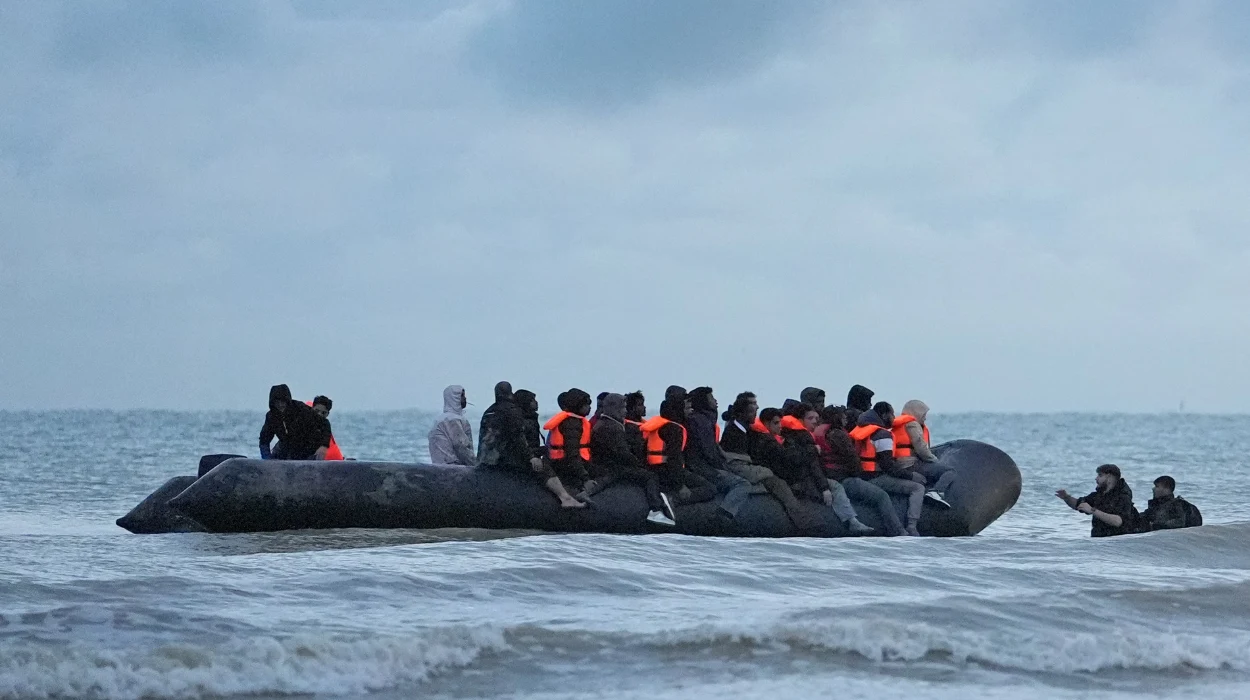
In the year ending June 2025, UK authorities detected 49,000 people arriving irregularly, with the vast majority (43,000 or 88%) crossing the English Channel in small boats.
The small boat route has been the predominant method for detecting irregular arrivals since 2020. From 2018 to the end of September 2025, approximately 171,000 people have arrived in the UK via this method.
Last month, UK Home Secretary Shabana Mahmood revealed changes to the British asylum and immigration system to tackle illegal migration, including a July deal with France called “one in, one out” to manage small boat crossings.