
Berlin (Parliament Politics Magazine) – Ukraine-US peace talks enter second day in Berlin as Kyiv considers dropping NATO ambitions, while EU leaders debate security guarantees and financial support.
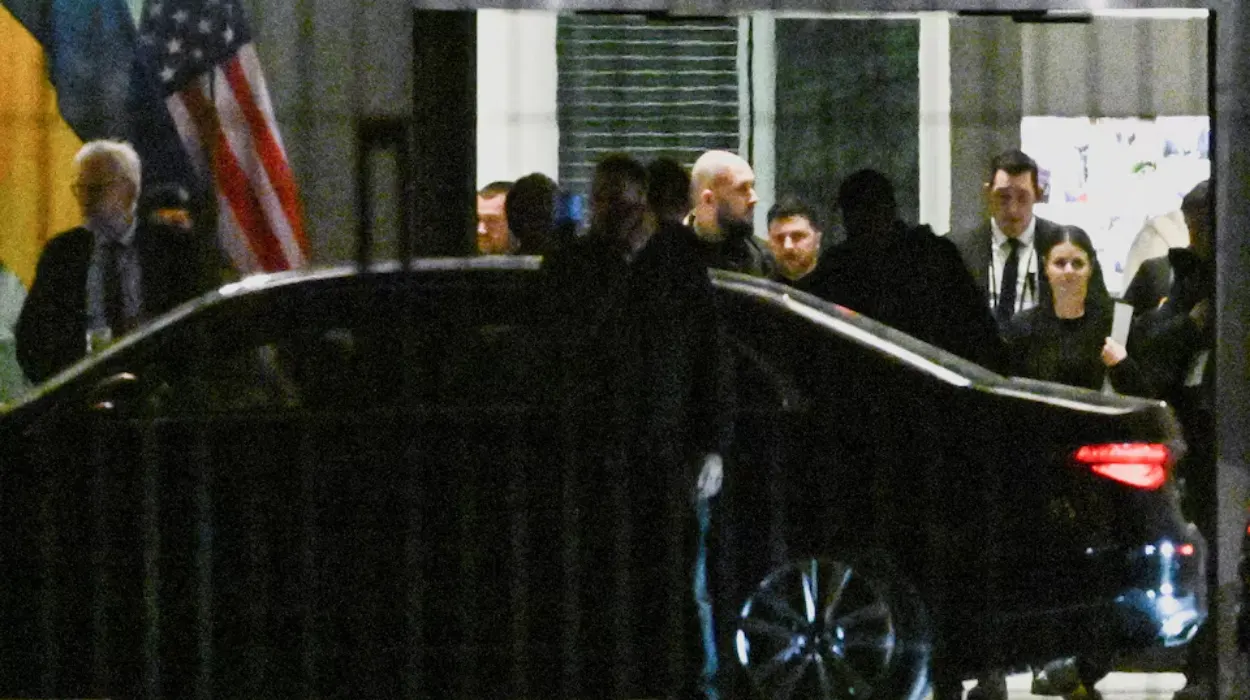
As reported by Andreas Rinke of Reuters, Ukrainian President Volodymyr Zelenskiy will continue discussions with US President Donald Trump’s envoys in Berlin on Monday, following America’s claims of “a lot of progress” toward ending Europe’s deadliest conflict since World War Two.
Which officials are meeting in the Ukraine peace talks in Berlin?
Officials from Ukraine, the US, Germany, and other European countries are meeting in Berlin for peace talks as of Monday, December 15, 2025. Russia is not participating in these direct discussions.
President Volodymyr Zelenskyy and members of his delegation, including Chief of the General Staff Andrii Hnatov and lead negotiator Rustem Umerov.
The US Special Envoy Steve Witkoff and Jared Kushner, President Trump’s son-in-law, are attending the peace talks, while Germany’s Chancellor Friedrich Merz is hosting the meetings.
Several European heads of state and government, along with senior EU and NATO officials, including British Prime Minister Keir Starmer, NATO Secretary General Mark Rutte, and European Commission President Ursula von der Leyen, are expected to join the Monday talks.
How are the Ukraine peace talks in Berlin addressing NATO ambitions and security guarantees?
Ukraine announced on Sunday, December 14, that it is prepared to drop its NATO membership bid in exchange for security assurances from Western powers. Despite this development, the extent of any agreement on major issues, such as control over Ukrainian territory and the potential to persuade Russia to accept a ceasefire, remains uncertain.
The talks come amid a decisive week for Europe, with EU leaders scheduled to meet on Thursday to determine if they can guarantee a loan to Ukraine using frozen Russian central bank assets.
The Trump administration has scrutinized Europe’s approach to migration, security, and tech regulation, while the European Union and national governments have struggled to craft a unified response.
On Monday, EU foreign ministers will convene in Brussels to finalize new sanctions against Russia, even as possible complications with an EU-Latin America trade deal may undermine their efforts to project strength.
German Foreign Minister Johann Wadephul said,
“We will continue to do everything we can to ensure that Ukraine can achieve the best possible negotiating position and, in the event of failure, that it has all the necessary means to retaliate against this war of aggression.”
Finnish President Alexander Stubb, closely involved in Ukraine negotiations and meeting President Zelenskiy Monday morning ahead of US talks, expressed a hopeful outlook.
“I think we are at a critical moment in negotiations for peace. And at the same time, we’re probably closer to a peace agreement than we have been at any time during these four years,”
he stated.
According to him, negotiators are working on three main documents: the framework of a 20-point peace plan, one on security guarantees for Ukraine, and plans for national reconstruction.
Mr Stubb added,
“So we’re looking at the details together with the Americans, Europeans, and the Ukrainians.”
EU foreign policy chief Kaja Kallas said Monday that seizing Ukraine’s Donbas region would “not be Putin’s endgame.”
She added,
“We have to understand that if he gets Donbas, then the fortress is down and then they definitely move on to taking the whole of Ukraine. If Ukraine goes, then other regions are also in danger.”
Last week, German Chancellor Friedrich Merz said that
“the decades of the Pax Americana are largely over for Europe and Germany as well.”
He warned that Mr Putin’s target is
“a fundamental change to the borders in Europe, the restoration of the old Soviet Union within its borders. If Ukraine falls, he won’t stop.”
What did Moscow say about Ukraine’s NATO ambitions and Donbas troops?
Russian President Vladimir Putin has repeatedly called on Kyiv to formally abandon its NATO ambitions and withdraw troops from around 10% of eastern Donbas still held by Ukraine.
Moscow has insisted that Ukraine must remain a neutral state and that NATO forces should not be deployed on its territory.
According to Russian sources, President Putin has demanded a formal written pledge from major Western nations to halt NATO expansion, a move that would prevent Ukraine, Georgia, Moldova, and other former Soviet states from joining.
How many drones hit targets in the latest Russia-Ukraine clashes?
Ukraine’s airports reported that Russia launched 153 drones overnight, of which 133 were intercepted while 17 reached their targets.
Russia’s defense ministry reported that 130 Ukrainian drones were shot down overnight, with another 16 destroyed between 7 a.m. and 8 a.m. local time.
Officials reported that 18 drones were intercepted above Moscow, forcing Domodedovo and Zhukovsky airports to suspend operations.
The UN’s human rights office (OHCHR) confirmed 49,431 civilian casualties in Ukraine as of July 31, 2025, including 35,548 injuries, though the true figures may be higher.’
Negotiations continue in Berlin as officials work to end the Ukraine-Russia conflict, aiming to secure a ceasefire and establish a long-term peace agreement.
