The British Museum, located in the Bloomsbury district of Central London, stands as one of the most iconic and comprehensive cultural institutions in the world. Founded in 1753 and opening to the public in 1759, it was the first national public museum established to bring together the story of human history, art, and culture under one roof, accessible to all.
Housing a permanent collection of approximately eight million objects, the British Museum offers an unparalleled window into the history of civilizations from every continent, spanning over two million years.
Foundations and Early Development: Sir Hans Sloane’s Legacy
The origins of the British Museum trace back to the extraordinary collection bequeathed by Sir Hans Sloane, an Anglo-Irish physician and naturalist, who amassed some 71,000 objects including books, manuscripts, natural history specimens, and antiquities during his lifetime.
Recognizing the importance of keeping his collection intact for public benefit, Sloane donated it to King George II for the nation, a gift that became the foundation of the Museum.
Officially established by an Act of Parliament in 1753, the Museum initially housed its collections in the seventeenth-century Montagu House, near the site of the present building. From its earliest days, it aimed to function as a “universal museum,” blending natural history, antiquities, manuscripts, and curiosities with the Enlightenment ideal that human knowledge, across cultures and times, could be pursued openly and shared freely for education and understanding.
The acquisition of several other important manuscript libraries—Cottonian, Harleian, and the King’s Old Royal Library—further enriched the Museum’s holdings, making it not only a museum but also a national library. The early 19th century saw significant additions, including the famed Rosetta Stone and classical sculptures, setting the scale and scholarly stature for future growth.
Architecture and Expansion: The Neoclassical Marvel
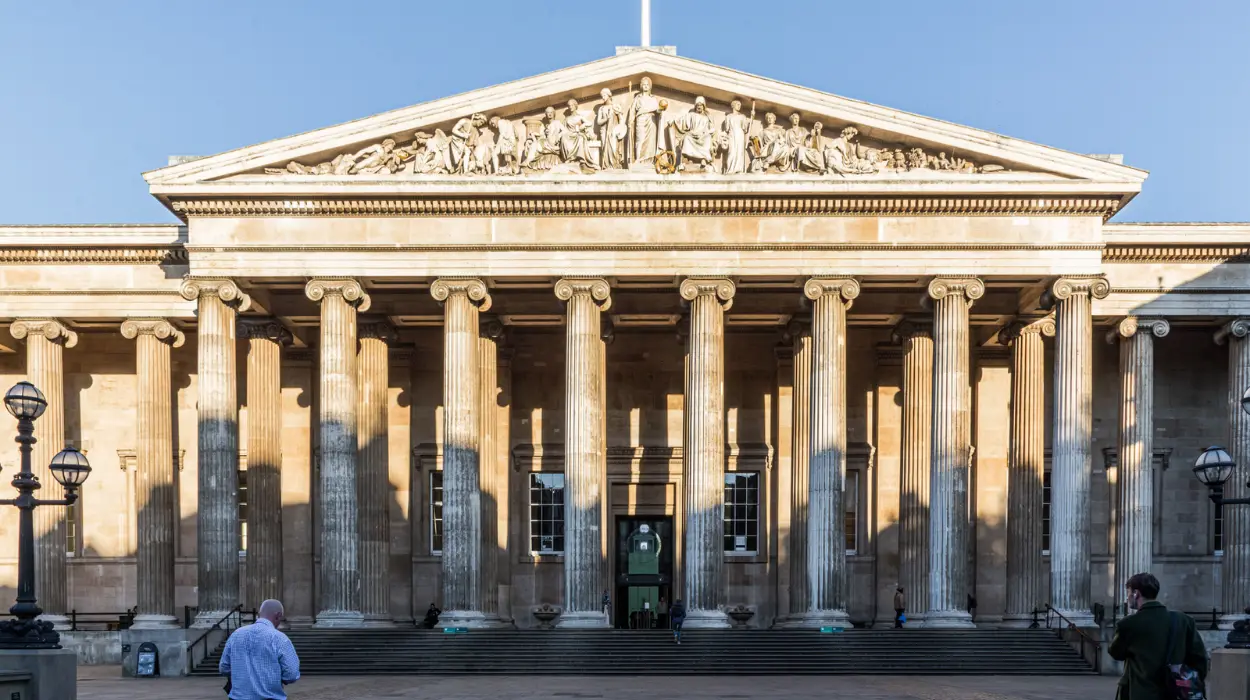
The present British Museum building, an architectural landmark designed by Sir Robert Smirke in the Greek Revival style, began construction in 1823, replacing the old Montagu House. Its iconic facade, featuring 44 Ionic columns inspired by the Temple of Athena in Asia Minor, symbolizes the grandeur and seriousness of the institution’s mission. The building grew over decades, expanding its wings and housing more galleries as collections multiplied.
One of its architectural highlights is the Round Reading Room, completed in 1857, which served as a focal point for researchers for nearly 150 years. The Reading Room was a beacon of scholarship where notable figures including Karl Marx and Virginia Woolf conducted study, embodying the Museum’s dual nature as a place for both public engagement and academic research.
The 20th century witnessed continuous expansion, including the creation of new departments, galleries, and the eventual separation of the British Library in 1973, which remained in the Museum building until moving to St Pancras in 1997. The opening of the Queen Elizabeth II Great Court in 2000, designed by Foster and Partners, transformed the central courtyard into the largest covered public square in Europe, welcoming millions of visitors annually.

Unrivaled Collections: A Global Tapestry of Cultures
The British Museum’s collections are unparalleled in breadth and depth, spanning every continent and era of human civilization. Its holdings encompass around eight million objects, only a fraction of which are on display, but all representing the rich diversity and interconnectedness of human culture.
The Museum’s Department of Egypt and Sudan houses the world’s largest and most comprehensive collection of Egyptian antiquities outside of Cairo, including masterpieces like the Rosetta Stone, colossal statues, and mummies that chronicle over 11,000 years of history. Ancient Greek and Roman sculpture, such as the Elgin Marbles taken from the Parthenon, represent some of the finest classical art in existence.
The museum’s Near Eastern, Asian, African, and American collections illuminate cultural histories from Mesopotamia to China, India to indigenous Americas.
Noteworthy are the Assyrian lion hunts, the Sutton Hoo Anglo-Saxon treasures, and ethnographic collections documenting diverse traditions and crafts worldwide. The Museum’s dedication to conserving and researching these artifacts fosters deeper understanding across temporal and geographic boundaries.
Educational Mission and Public Engagement
Since its inception, the British Museum has been committed to public education and accessibility. Initially restricted to a select few, public visiting hours and free entry policies democratized access to cultural heritage. Today, it is among the most visited museums globally, attracting millions of visitors annually, with offerings ranging from permanent galleries to ever-changing exhibitions, lectures, educational programs, and digital access.
The Museum’s research and conservation departments pioneer advances in archaeology, preservation sciences, and cultural studies, contributing to global knowledge and fostering international cooperation. Its extensive loan programs ensure that treasures travel, enriching cultural dialogue worldwide while highlighting concerns about provenance and ethical stewardship.
Challenges and Controversies
The British Museum’s position as custodian of many artifacts obtained during the British Empire’s colonial period has generated ongoing debates about repatriation and cultural ownership. Notable disputes include calls for the return of the Elgin Marbles from Greece and the Benin Bronzes to Nigeria. These complex issues intertwine legal, ethical, historical, and diplomatic considerations, reflecting broader questions about cultural heritage and post-colonial justice.
The Museum engages in active dialogue and policy development to address these concerns transparently, balancing scholarly research, public education, and respectful international relationships.
Highlights of the British Museum
- Founded in 1753 from Sir Hans Sloane’s vast collection; opened in 1759 as the world’s first public national museum.
- The current neoclassical building designed by Sir Robert Smirke was constructed between 1823 and the mid-19th century.
- Possesses over eight million objects spanning two million years of human history, with notable collections from Egypt, Greece, Rome, the Near East, Africa, Asia and the Americas.
- The Queen Elizabeth II Great Court, opened in 2000, is Europe’s largest covered public square, integrating the historic Reading Room.
- The Museum is dedicated to free public access, scholarly research, and global cultural engagement while navigating repatriation controversies.
The British Museum remains a monumental institution embodying humanity’s shared history, creativity, and diversity. From its Enlightenment roots through centuries of expansion and scholarship, it stands as a beacon of public knowledge and cultural stewardship.
The Museum’s broad collections not only showcase artistic and archaeological wonders but also facilitate cross-cultural understanding and dialogue. As it continues to evolve, the British Museum plays a pivotal role in preserving the past while engaging global audiences for a richer, more informed future.