
Amid the sprawling displays of advanced hardware at Eurosatory, one of the world’s premier defence and security trade exhibition, Côte d’Ivoire’s Deputy Prime Minister and Minister of Defence, Téné Birahima Ouattara, signalled his nation’s emergence as the primary security anchor in the troubled Sahel region.
Calling for renewed co-operation with neighbouring Mali and Burkina Faso, Mr Ouattara, set out how his country has taken the fight to terror groups trying to operate in the West African country and the wider region, revealing how Abidjan has become a military bulwark against a tide of jihadi groups.
The Deputy Prime Minister, who is increasingly being viewed by Western governments as a potential successor to his brother the current President, went on to talk about the shifting security landscape of the Sahel. While both Burkina Faso and Mali have suffered from persistent and devastating terror attacks, they have seen them distance themselves from longstanding partners.
Worryingly, the military administrations in Bamako and Ouagadougou have recently expelled French and American forces, opting instead for closer security ties with Russia. In this vacuum of traditional influence, Côte d’Ivoire has stepped forward to occupy the strategic role as a buffer state between the volatile Sahelian interior and the coastal nations of the Gulf of Guinea.
Addressing the threat with a pragmatic focus on regional unity, Téné Birahima Ouattara was clear in his assessment of the modern insurgent threat. “Terrorism, as it currently presents itself, cannot be defeated by a single state,” he remarked during his visit to the French security show. “There must be collaboration, a pooling of forces.” This diplomatic overture, described by the Deputy Prime Minister as being “sincerely ready” to resume cooperation, comes at a time when the cross-border nature of the threat is more apparent than ever. Groups like Jama’at Nusrat ul-Islam wa al-Muslimin (JNIM), which now incorporates the remnants of Al-Qaida in the Islamic Maghreb (AQIM), have proven adept at exploiting porous borders and dense forest cover.
The Ivorian response to the encroaching threat has been characterised by significant domestic investment and a rapid expansion of security personnel. In the northern regions bordering Mali and Burkina Faso, the government has deployed more than 3,000 men to directly tackle the threat of terrorism. This surge in manpower is part of a broader strategy that has seen the number of police in the north more than double over the past five years.
This domestic buildup is underpinned by a robust financial commitment. In 2025 alone, the combined budget for the Ministries of Security and Defence reached approximately €1.95 billion, reflects the state’s recognition that national security is the foundational to economic prosperity.
While many of its neighbours face economic stagnation alongside security crises, Côte d’Ivoire remains one of the fastest-growing economies in sub-Saharan Africa, with growth projected at 6.4% through 2026. This economic dynamism allows Abidjan to fund not only its military, but also social programmes designed to prevent radicalisation.
In remote northern villages, the state is actively working to undercut the financial allure of militant groups. Supported by international development funding, the government has prioritised the construction of primary schools, the deployment of mobile health clinics, and the provision of vocational micro-loans for young cashew farmers. These measures aim to address the root causes of recruitment by providing a viable alternative to the financial promises of jihadist organisations.
Alongside this economic programme Côte d’Ivoire’s has been building up its military and expanding its elite units. In the coastal town of Jacqueville, west of Abidjan, an EU-backed counter-terrorism academy has become the focal point for high-level tactical training. This facility, which opened five years ago, is designed to produce elite units capable of countering the evolving tactics of groups like JNIM. These insurgents have increasingly turned to sophisticated methods, including a dramatic increase in the use of armed drones, which reportedly jumped from fewer than ten recorded strikes in 2024 to approximately 80 in 2025.
Beyond European training, Côte d’Ivoire has actively sought deepened intelligence cooperation with the United States. Recent reports indicate the Ivorian government has been pushing for the deployment of US spy planes and drones to assist in tracking Al-Qaeda-linked militants along the northern borders. The request for advanced aerial surveillance highlights the technological gap that coastal states must close to effectively monitor the vast, often inaccessible terrain of the borderlands.
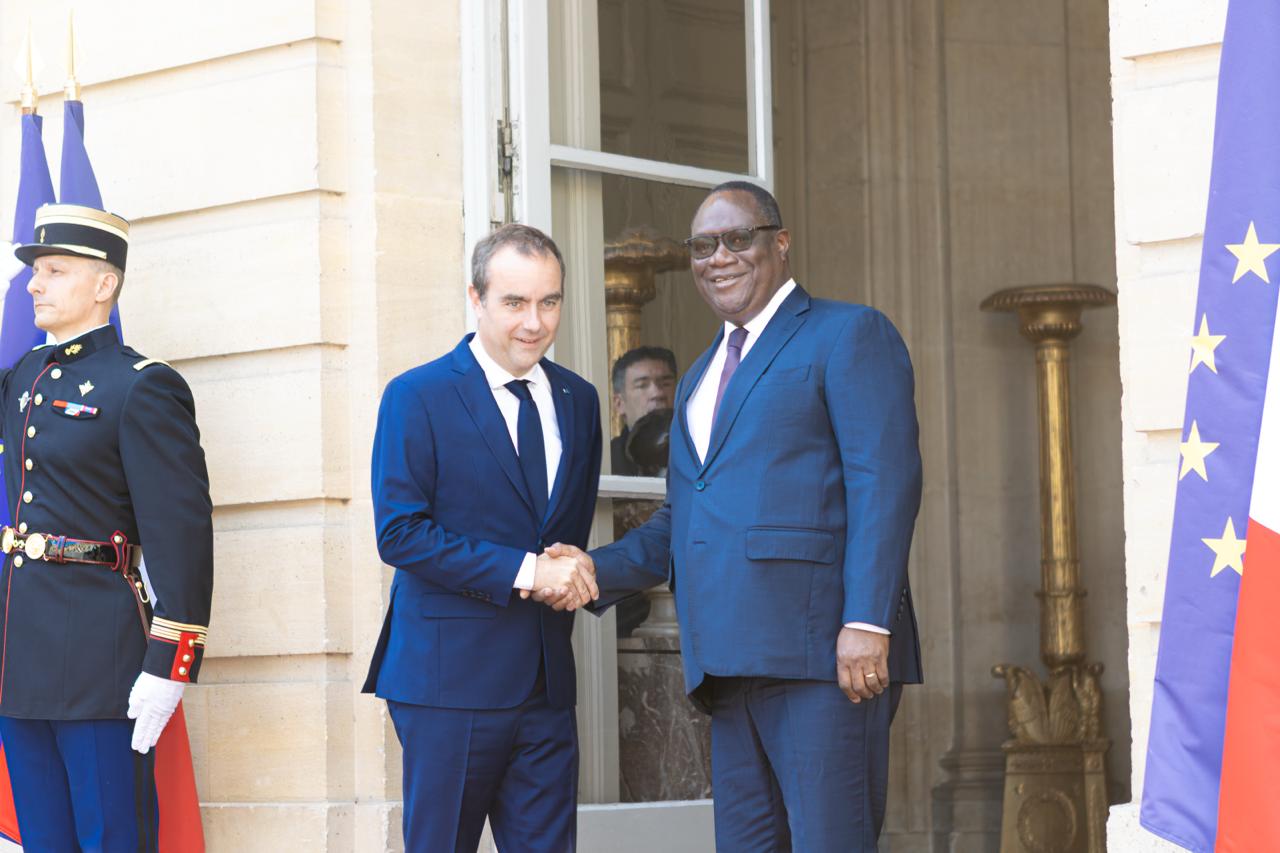
The relationship with France and other European nations including the UK remain a cornerstone of Ivorian foreign policy. During his visit to Paris, Deputy Prime Minister Ouattara met with French Prime Minister Sébastien Lecornu to discuss ongoing security efforts. Ouattara declared the relationship to be one of “exemplary co-operation,” specifically citing the vital roles of shared intelligence, high-grade equipment, and specialized training. While other regional powers have pivoted away from Paris, Côte d’Ivoire has doubled down on the partnership, viewing it as a strategic necessity.
A view shared by UK officials. Ambassador James Kariuki, UK Chargé d’Affaires to the UN, declared in November that “The United Kingdom shares the concern that Islamic State and Al-Qaeda affiliates are continuing to expand across West Africa and the Sahel, driving instability and committing deadly attacks against civilians”
The Ambassador added that “the UK remains committed to working with African partners and supporting African-led initiatives to promote stability and security” – including funding and training for Côte d’Ivoire’s Counter Terrorism Academy.
The current strategy and success in tackling terror groups, was a direct response to Grand Bassam attack. On 13th March 2016, gunmen from AQIM opened fire at a popular beach resort, killing 19 people. The event traumatised the nation and served as a catalyst for the reforms which are now delivering an improved security situation seen today.
At a ceremony to commemorate the decade since the attack, Ouattara noted that Ivorian forces have since “strengthened their operational vigilance to ensure that such tragedies never happen again.”
The threat, however, has not vanished; it has merely migrated. While Grand Bassam remains a peaceful tourist destination once again, the “black Sunday” of 2016 remains a stark reminder of what is at stake. The 2020 attack in the village of Kafolo, which saw 14 Ivorian soldiers killed by militants from the Katiba Macina group, further underscored the lethality of the threat lurking just across the border.
The political weight behind these security initiatives is substantial. Téné Birahima Ouattara, the younger brother of President Alassane Ouattara, is widely seen as a potential successor and a key architect of the nation’s current stability. His dual role as Minister of Defence and a central political figure ensures that the security apparatus remains closely aligned with the executive’s broader economic and diplomatic goals.
Under his guidance, Côte d’Ivoire has emerged as a proactive and dependable leader in West African security and while challenges remain, Mr Ouattara’s strategy is being held up as a model the West would deeply like to see other countries in the region copy.
Côte d’Ivoire takes lead in regional War on Terror

9 mins read
Latest from Europe
BRUSSELS, June 17 (Parliament Politics Magazine) – European allies and Canada have significantly increased their military

BERN, June 14 (Parliament Politics Magazine) – Swiss voters have rejected a controversial proposal to cap
ZURICH, June 14 (Parliament Politics Magazine) – Swiss citizens cast their ballots on Sunday to determine
VILNIUS, June 13 (Parliament Politics Magazine) – Authorities in Vilnius briefly warned residents of a potential
BRUSSELS, June 12 (Parliament Politics Magazine) – An extensive overhaul of immigration and asylum policy entered