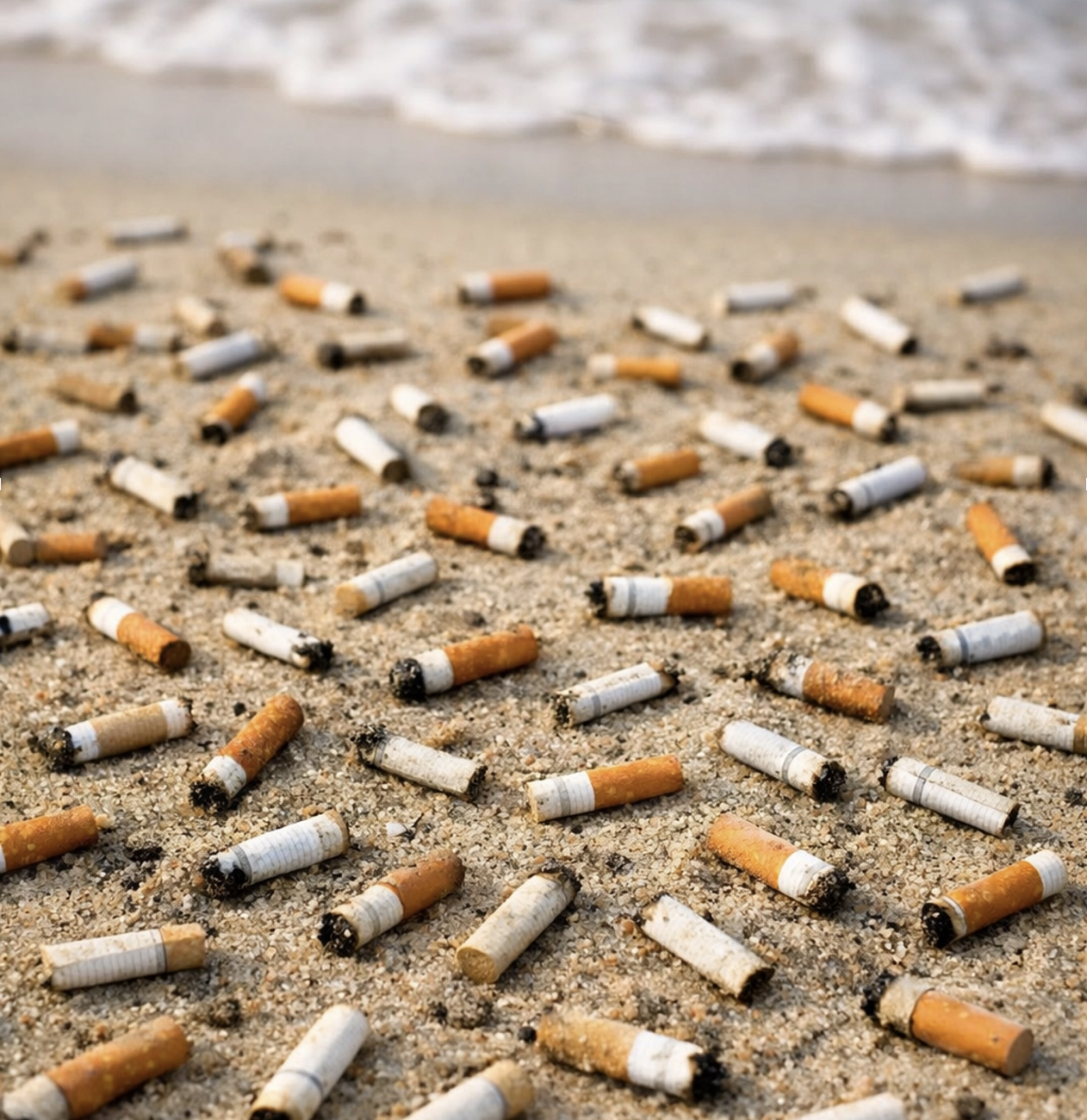
Walk down any street in Britain, scan any beach, check any park. The chances are you’ll spot them within seconds: cigarette butts. They’re everywhere. And here’s the uncomfortable truth: these aren’t just unsightly litter. They’re plastic pollution on a staggering scale, and they’re the single most common item of plastic rubbish found worldwide.
As the Tobacco and Vapes Bill approaches its Report Stage in the House of Lords, there’s a golden opportunity to tackle this environmental disaster head-on. Parliament should amend the legislation to ban plastic cigarette filters entirely. This isn’t about scoring political points or virtue signalling. It’s common sense environmental policy that would make an immediate, tangible difference.
Let’s talk numbers. Cigarette butts made up nearly 30% of all trash collected during California’s Coastal Cleanup Day in 2020. That’s not an outlier: it’s the global pattern. These filters are absolutely everywhere, from pristine beaches to city centres, from rivers to countryside footpaths.
In the UK an estimated 3.9 million are littered every day, or roughly 6,000 per parliamentary constituency per day, every day 365 days a year. And for those wanting a more visual idea, 6,000 is roughly a shopping bag full.
What makes this worse is that most people don’t realise what cigarette filters actually are. They’re not cotton or paper: they’re plastic. Specifically, they’re made from cellulose acetate, that sounds eco-friendly but absolutely isn’t biodegradable in any meaningful sense. These filters don’t break down naturally. Instead, they persist in the environment for years, potentially centuries, slowly fragmenting into microplastics that contaminate soil, water, and marine ecosystems.
Each discarded filter sheds microfibers and leaches toxic chemicals into the environment. We’re talking about heavy metals, nicotine residue, and a cocktail of carcinogens seeping into the ground and waterways. The environmental damage compounds with every single cigarette butt thoughtlessly tossed aside.
Here’s where it gets really frustrating, there are alternatives. If the industry wanted to change this they could easily move to biodegradable alternatives. One product was even developed here in Leeds and can be manufactured in Devon.
This isn’t a fringe position. Public opinion strongly backs action on cigarette filter pollution. A poll we commissioned last year found banning plastic cigarette filters is supported by the public (including smokers). The poll, from Whitestone Insight, a member of the British Polling Council, asked over 2,000 people for their views on this issue.
Asked, “Would you agree or disagree with these statements? Cigarette manufacturers should be required by law to switch from using plastics in cigarette butts to a fully biodegradable alternative”, almost nine in 10 UK adults (86 per cent) agreed, while just one in 20, 6 per cent disagreed.
Interestingly even among current smokers the vast majority (77 per cent) supported the change. Support was high across every age group, social group and region.
In contrast, asked if cigarette manufacturers should be able to continue to use plastic filters, just 13 per cent agreed. Even among smokers, this figure rose to just one in four (25 per cent).
The survey also found nearly eight in 10 (78 per cent), support the Government levying additional taxes on cigarette brands that refuse to switch from traditional plastic butts, including half, (51 per cent) of smokers. While more than eight in ten (84 per cent) of UK adults would support cigarette manufacturers being fined for not switching to biodegradable butts with the revenues going to pay for cleaning up the environment.
It is clear from these answers that people are increasingly aware of plastic pollution’s devastating impact, and when they learn that cigarette butts are the world’s most common item of plastic litter, support for a change becomes obvious.
The argument isn’t difficult to make because it’s self-evidently sensible. Plastic cigarette filters cause massive environmental damage. Why on earth should they remain legal?
Tobacco companies will inevitably claim that moving to biodegradable filters would be impossible to implement or economically devastating. Don’t believe a word of it. The House of Lords, should say to them, there are two choices, move to biodegradable filter, or no filters.
This is why we hope all peers will back this change. Simply put this isn’t a partisan debate. Environmental protection isn’t the exclusive domain of any political party. Conservatives should support it as a measure that reduces taxpayer-funded cleanup costs and protects the British countryside. Labour and Liberal Democrats can back it as environmental justice and pollution control. The SNP, Plaid Cymru, and Greens have obvious reasons to support it.
There’s no principled opposition here. No political philosophy requires defending the right of tobacco companies to scatter plastic pollution across every corner of the country.
The Tobacco and Vapes Bill is already making its way through Parliament with substantial cross-party support. Adding a ban on plastic cigarette filters would strengthen the legislation without undermining its core objectives. It would demonstrate that Parliament can act decisively on environmental issues even when they involve powerful commercial interests.
As the Bill reaches the Report Stage in the House of Lords, the practicalities are straightforward. An amendment banning the sale of cigarettes with plastic filters would be clear, enforceable, and give the industry reasonable time to adjust. Implementation could be phased over 12-24 months, allowing manufacturers to adapt their products and retailers to clear existing stock.
Enforcement would use existing tobacco regulation infrastructure. Trading Standards officers already monitor tobacco sales for age restrictions, illicit products, and packaging compliance. Adding filter composition to that list doesn’t require building new bureaucracy: it’s a natural extension of current practice.
With Parliament likely to support the provisions in the legislation to create a smoke-free generation by gradually raising the age at which tobacco can be purchased. Those in favour if argue it’s ambitious, forward-thinking policy addressing a major public health challenge.
But it’s incomplete without tackling the environmental disaster of plastic filters. This is the legislative vehicle perfectly positioned to make this change. Miss this opportunity, and we’ll be waiting years for another suitable Bill to come along: years during which billions more plastic cigarette butts accumulate in our environment.
The evidence is clear. The public support is there. The legislative mechanism exists. The environmental and health cases are overwhelming. All that’s missing is parliamentary will to add this common-sense amendment.
Peers should seize this opportunity. Ban plastic cigarette filters. Filter out the filth. Make the Tobacco and Vapes Bill the comprehensive legislation Britain needs.
Filtering Out the Filth: Why the Tobacco and Vapes Bill Must Ban Plastic Filters