

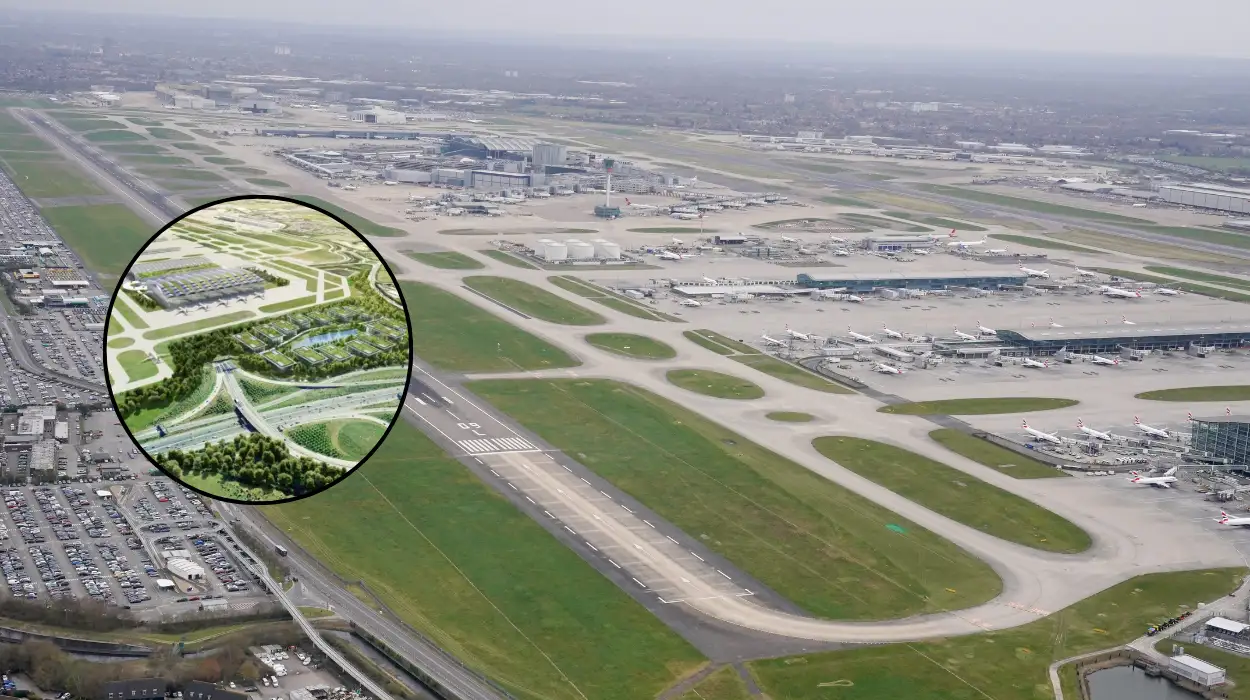
Hillingdon (Parliament Politics Magazine) – Ministers have endorsed Heathrow Airport owners’ plans to relocate a section of the M25 to enable construction of a third runway in Hillingdon.
Heathrow’s own plans were “the most credible and deliverable option,” according to Transport Secretary Heidi Alexander, who rejected an alternative proposal from Arora Group.
In addition to a 3,500-meter runway, the Heathrow plans call for the construction of a new M25 tunnel and bridges 130 meters west of the current road in Hillingdon.
A consortium led by hotel magnate Surinder Arora proposed the Arora plan, which called for a 2,800-meter runway that would not necessitate rerouting the M25.
However, Ms. Alexander stated in a written declaration to Parliament that the plan would still have “a considerable impact” on the road and necessitate the forced acquisition of additional residences near the airport.
Expanding the airport
“will mean more connectivity, increased trade, improved passenger experience and a huge economic boost for the British businesses that will help design and build it,”
according to a Heathrow representative who applauded the decision.
However, the spokesman called for “definitive decisions” from the government and the Civil Aviation Authority by mid-December, adding that “further clarity” was required about the regulation of the project’s next phase.
Mr. Arora stated that competition was
“absolutely imperative to keep costs under control at the airport”
and that his organization “accepts today’s announcement” while still hoping to be selected as the “promoter” of the third runway rather than Heathrow Airport.
The estimated £33 billion cost of the proposed third runway, including £1.5 billion for moving the M25, is anticipated to be entirely covered by private funding.
Heathrow’s capacity will rise to 756,000 flights and 150 million people annually as a result.
The third runway will be operational by 2035, and the government hopes to decide on a planning application for Heathrow’s expansion by the next election.
The ruling on Tuesday would
“allow a decision on a third runway plan this Parliament which meets our key tests including on the environment and economic growth,”
according to Ms. Alexander.
She added:
“We’re acting swiftly and decisively to get this project off the ground so we can realise its transformational potential for passengers, businesses and our economy sooner.”
As the government revises the Airports National Policy Statement, which controls airport planning choices, the ideas will be subject to more comment.
In order to make sure the extension is in line with the government’s pledges to cut carbon emissions, the Transport Secretary has also promised to consult the independent Climate Change Committee.
How will environmental impact assessments address noise and air quality?
Environmental Impact Assessments( EIAs) address noise and air quality by conducting comprehensive birth measures and prophetic modeling to understand current conditions and read changes caused by the development. For noise, this involves detailed noise and vibration monitoring using technical equipment to measure sound pressure situations, frequentness, and durations in the affected area over time.
For air quality, EIAs assess contaminant situations including particulate matter, nitrogen oxides, carbon monoxide, and unpredictable organic composites. These assessments consider sources similar as increased business, construction ministry, or functional emigrations. Advanced modeling predicts how pollution disperses locally and impacts public health and ecosystems.
Grounded on these findings, EIAs propose mitigation measures similar as sound walls, defined construction timing to minimize noise dislocation, use of quieter machinery, business operation to reduce traffic and emigrations, and air filtration or foliage buffers.
